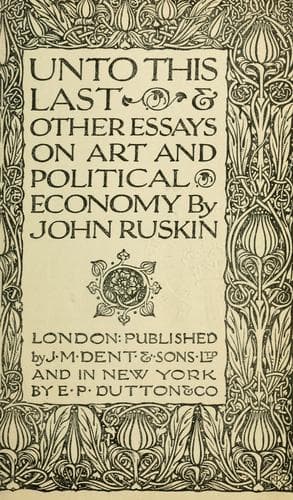
Unto This Last, and Other Essays on Political EconomyRuskin, John
General
Unto This Last, and Other Essays on Political Economy
Ruskin, John
Art; Economics
The Physician, rather than leave his post in plague.
The Pastor, rather than teach Falsehood.
The Lawyer, rather than countenance Injustice.
The Merchant--What is _his_ "due occasion" of death? It is the main
question for the merchant, as for all of us. For, truly, the man who
does not know when to die, does not know how to live.
Observe, the merchant's function (or manufacturer's, for in the broad
sense in which it is here used the word must be understood to include
both) is to provide for the nation. It is no more his function to get
profit for himself out of that provision than it is a clergyman's
function to get his stipend. The stipend is a due and necessary
adjunct, but not the object, of his life, if he be a true clergyman,
any more than his fee (or _honorarium_) is the object of life to a
true physician. Neither is his fee the object of life to a true
merchant. All three, if true men, have a work to be done irrespective
of fee--to be done even at any cost, or for quite the contrary of fee;
the pastor's function being to teach, the physician's to heal, and the
merchant's, as I have said, to provide. That is to say, he has to
understand to their very root the qualities of the thing he deals in,
and the means of obtaining or producing it; and he has to apply all
his sagacity and energy to the producing or obtaining it in perfect
state, and distributing it at the cheapest possible price where it is
most needed.
And because the production or obtaining of any commodity involves
necessarily the agency of many lives and hands, the merchant becomes
in the course of his business the master and governor of large masses
of men in a more direct, though less confessed way, than a military
officer or pastor; so that on him falls, in great part, the
responsibility for the kind of life they lead: and it becomes his
duty, not only to be always considering how to produce what he sells
in the purest and cheapest forms, but how to make the various
employments involved in the production, or transference of it, most
beneficial to the men employed.
And as into these two functions, requiring for their right exercise
the highest intelligence, as well as patience, kindness, and tact, the
merchant is bound to put all his energy, so for their just discharge
he is bound, as soldier or physician is bound, to give up, if need be,
his life, in such way as it may be demanded of him. Two main points he
has in his providing function to maintain: first, his engagements
(faithfulness to engagements being the real root of all possibilities
in commerce); and, secondly, the perfectness and purity of the thing
provided; so that, rather than fail in any engagement, or consent to
any deterioration, adulteration, or unjust and exorbitant price of
that which he provides, he is bound to meet fearlessly any form of
distress, poverty, or labour, which may, through maintenance of these
points, come upon him.
Public-domain text, read in full here on John Shaqi.
Reviews
Reviews
No reviews yet
Be the first to share your thoughts on this work.
Elsewhere in the archive
Join the Discussion
Join the discussion
Sign in to leave a comment or review.
Sign InorCreate an account