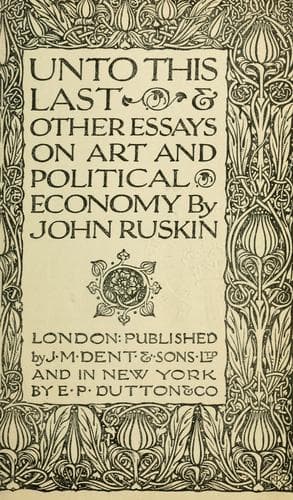
Unto This Last, and Other Essays on Political EconomyRuskin, John
General
Unto This Last, and Other Essays on Political Economy
Ruskin, John
Art; Economics
I have not, of course, time to insist on the nature or details of
government of this kind; only I wish to plead for your several and
future consideration of this one truth, that the notion of Discipline
and Interference lies at the very root of all human progress or power;
that the "Let alone" principle is, in all things which man has to do
with, the principle of death; that it is ruin to him, certain and
total, if he lets his land alone--if he lets his fellow-men alone--if
he lets his own soul alone. That his whole life, on the contrary,
must, if it is healthy life, be continually one of ploughing and
pruning, rebuking and helping, governing and punishing; and that
therefore it is only in the concession of some great principle of
restraint and interference in national action that he can ever hope to
find the secret of protection against national degradation. I believe
that the masses have a right to claim education from their government;
but only so far as they acknowledge the duty of yielding obedience to
their government. I believe they have a right to claim employment from
their governours; but only so far as they yield to the governour the
direction and discipline of their labour; and it is only so far as
they grant to the men whom they may set over them the father's
authority to check the childishnesses of national fancy, and direct
the waywardnesses of national energy, that they have a right to ask
that none of their distresses should be unrelieved, none of their
weaknesses unwatched; and that no grief, nor nakedness, nor peril
should exist for them, against which the father's hand was not
outstretched, or the father's shield uplifted.[4]
[4] Compare Wordsworth's Essay on the Poor-Law Amendment Bill.
I quote one important passage:--"But, if it be not safe to
touch the abstract question of man's right in a social state
to help himself even in the last extremity, may we not still
contend for the duty of a Christian government, standing _in
loco parentis_ towards all its subjects, to make such
effectual provision that no one shall be in danger of
perishing either through the neglect or harshness of its
legislation? Or, waiving this, is it not indisputable that
the claim of the State to the allegiance, involves the
protection of the subject? And, as all rights in one party
impose a correlative duty upon another, it follows that the
right of the State to require the services of its members,
even to the jeoparding of their lives in the common defence,
establishes a right in the people (not to be gainsaid by
utilitarians and economists) to public support when, from
any cause, they may be unable to support themselves."--(See
note 2nd in Addenda [p. 90]).
Public-domain text, read in full here on John Shaqi.
Reviews
Reviews
No reviews yet
Be the first to share your thoughts on this work.
Join the Discussion
Join the discussion
Sign in to leave a comment or review.
Sign InorCreate an account