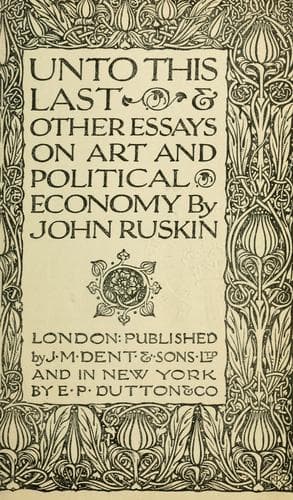
Unto This Last, and Other Essays on Political Economy — John Shaqi
Unto This Last, and Other Essays on Political EconomyRuskin, John
General
Unto This Last, and Other Essays on Political Economy
Ruskin, John
Art; Economics
Now, I have pressed this upon you at more length than is needful or
proportioned to our present purposes of inquiry, because I would not
for the first time speak to you on this subject of political economy
without clearly stating what I believe to be its first grand
principle. But its bearing on the matter in hand is chiefly to prevent
you from at once too violently dissenting from me when what I may
state to you as advisable economy in art appears to imply too much
restraint or interference with the freedom of the patron or artist. We
are a little apt, though, on the whole a prudent nation, to act too
immediately on our impulses, even in matters merely commercial; much
more in those involving continual appeals to our fancies. How far,
therefore, the proposed systems or restraints may be advisable, it is
for you to judge; only I pray you not to be offended with them merely
because they _are_ systems and restraints. Do you at all recollect
that interesting passage of Carlyle, in which he compares, in this
country and at this day, the understood and commercial value of man
and horse; and in which he wonders that the horse, with its inferior
brains and its awkward hoofiness, instead of handiness, should be
always worth so many tens or scores of pounds in the market, while the
man, so far from always commanding his price in the market, would
often be thought to confer a service on the community by simply
killing himself out of their way? Well, Carlyle does not answer his
own question, because he supposes we shall at once see the answer. The
value of the horse consists simply in the fact of your being able to
put a bridle on him. The value of the man consists precisely in the
same thing. If you can bridle him, or which is better, if he can
bridle himself, he will be a valuable creature directly. Otherwise, in
a commercial point of view, his value is either nothing, or accidental
only. Only, of course, the proper bridle of man is not a leathern one:
what kind of texture it is rightly made of, we find from that command,
"Be ye not as the horse or as the mule which have no understanding,
whose mouths must be held in with bit and bridle." You are not to be
without the reins, indeed, but they are to be of another kind; "I will
guide thee with mine Eye." So the bridle of man is to be the Eye of
God; and if he rejects that guidance, then the next best for him is
the horse's and the mule's, which have no understanding; and if he
rejects that, and takes the bit fairly in his teeth, then there is
nothing left for him than the blood that comes out of the city, up to
the horsebridles.
Public-domain text, read in full here on John Shaqi.
Reviews
Reviews
No reviews yet
Be the first to share your thoughts on this work.
Join the Discussion
Join the discussion
Sign in to leave a comment or review.
Sign InorCreate an account