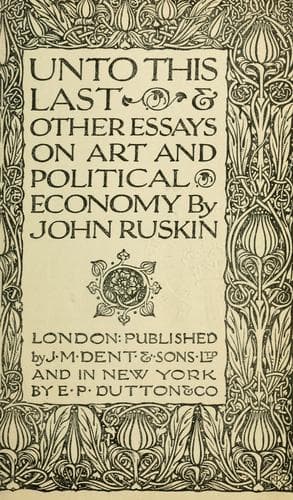
Unto This Last, and Other Essays on Political EconomyRuskin, John
General
Unto This Last, and Other Essays on Political Economy
Ruskin, John
Art; Economics
And therefore, the idea that directions can be given for the gaining
of wealth, irrespectively of the consideration of its moral sources,
or that any general and technical law of purchase and gain can be set
down for national practice, is perhaps the most insolently futile of
all that ever beguiled men through their vices. So far as I know,
there is not in history record of anything so disgraceful to the human
intellect as the modern idea that the commercial text, "Buy in the
cheapest market and sell in the dearest," represents, or under any
circumstances could represent, an available principle of national
economy. Buy in the cheapest market?--yes; but what made your market
cheap? Charcoal may be cheap among your roof timbers after a fire, and
bricks may be cheap in your streets after an earthquake; but fire and
earthquake may not therefore be national benefits. Sell in the
dearest?--yes, truly; but what made your market dear? You sold your
bread well to-day; was it to a dying man who gave his last coin for
it, and will never need bread more, or to a rich man who to-morrow
will buy your farm over your head; or to a soldier on his way to
pillage the bank in which you have put your fortune?
None of these things you can know. One thing only you can know,
namely, whether this dealing of yours is a just and faithful one,
which is all you need concern yourself about respecting it; sure thus
to have done your own part in bringing about ultimately in the world a
state of things which will not issue in pillage or in death. And thus
every question concerning these things merges itself ultimately in the
great question of justice, which, the ground being thus far cleared
for it, I will enter upon in the next paper, leaving only, in this,
three final points for the reader's consideration.
It has been shown that the chief value and virtue of money consists in
its having power over human beings; that, without this power, large
material possessions are useless, and, to any person possessing such
power, comparatively unnecessary. But power over human beings is
attainable by other means than by money. As I said a few pages back,
the money power is always imperfect and doubtful; there are many
things which cannot be reached with it, others which cannot be
retained by it. Many joys may be given to men which cannot be bought
for gold, and many fidelities found in them which cannot be rewarded
with it.
Trite enough,--the reader thinks. Yes: but it is not so trite,--I wish
it were,--that in this moral power, quite inscrutable and immeasurable
though it be, there is a monetary value just as real as that
represented by more ponderous currencies. A man's hand may be full of
invisible gold, and the wave of it, or the grasp, shall do more than
another's with a shower of bullion. This invisible gold, also, does
not necessarily diminish in spending. Political economists will do
well some day to take heed of it, though they cannot take measure.
Public-domain text, read in full here on John Shaqi.
Reviews
Reviews
No reviews yet
Be the first to share your thoughts on this work.
Elsewhere in the archive
Join the Discussion
Join the discussion
Sign in to leave a comment or review.
Sign InorCreate an account