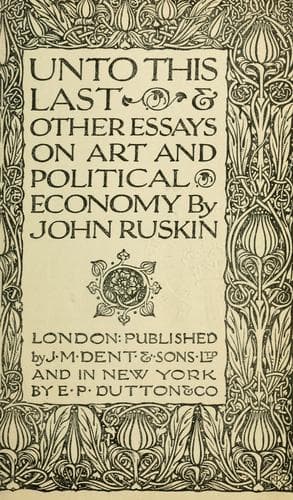
Unto This Last, and Other Essays on Political EconomyRuskin, John
General
Unto This Last, and Other Essays on Political Economy
Ruskin, John
Art; Economics
I should have regretted the need of pointing out inconsistency in any
portion of Mr. Mill's work, had not the value of his work proceeded
from its inconsistencies. He deserves honour among economists by
inadvertently disclaiming the principles which he states, and tacitly
introducing the moral considerations with which he declares his
science has no connection. Many of his chapters, are, therefore, true
and valuable; and the only conclusions of his which I have to dispute
are those which follow from his premises.
Thus, the idea which lies at the root of the passage we have just been
examining, namely, that labour applied to produce luxuries will not
support so many persons as labour applied to produce useful articles,
is entirely true; but the instance given fails--and in four directions
of failure at once--because Mr. Mill has not defined the real meaning
of usefulness. The definition which he has given--"capacity to satisfy
a desire, or serve a purpose" (III. i. 2)--applies equally to the iron
and silver; while the true definition,--which he has not given, but
which nevertheless underlies the false verbal definition in his mind,
and comes out once or twice by accident (as in the words "any support
to life or strength" in I. i. 5)--applies to some articles of iron,
but not to others, and to some articles of silver, but not to others.
It applies to ploughs, but not to bayonets; and to forks, but not to
filigree.[48]
[48] Filigree: that is to say, generally, ornament dependent
on complexity, not on art.
The eliciting of the true definition will give us the reply to our
first question, "What is value?" respecting which, however, we must
first hear the popular statements.
"The word 'value,' when used without adjunct, always means, in
political economy, value in exchange" (Mill, III. i. 3). So that,
if two ships cannot exchange their rudders, their rudders are, in
politico-economic language, of no value to either.
But "the subject of political economy is wealth."--(Preliminary
remarks, page 1.)
And wealth "consists of all useful and agreeable objects which possess
exchangeable value."--(Preliminary remarks, page 10.)
It appears then, according to Mr. Mill, that usefulness and
agreeableness underlie the exchange value, and must be ascertained to
exist in the thing, before we can esteem it an object of wealth.
Now, the economical usefulness of a thing depends not merely on its
own nature, but on the number of people who can and will use it. A
horse is useless, and therefore unsaleable, if no one can ride,--a
sword if no one can strike, and meat, if no one can eat. Thus every
material utility depends on its relative human capacity.
Public-domain text, read in full here on John Shaqi.
Reviews
Reviews
No reviews yet
Be the first to share your thoughts on this work.
Elsewhere in the archive
Join the Discussion
Join the discussion
Sign in to leave a comment or review.
Sign InorCreate an account