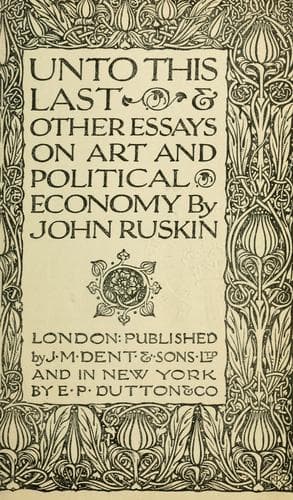
Unto This Last, and Other Essays on Political EconomyRuskin, John
General
Unto This Last, and Other Essays on Political Economy
Ruskin, John
Art; Economics
I have hitherto spoken of all labour as profitable; because it is
impossible to consider under one head the quality or value of labour,
and its aim. But labour of the best quality may be various in aim. It
may be either constructive ("gathering," from con and struo), as
agriculture; nugatory, as jewel-cutting; or destructive ("scattering,"
from de and struo), as war. It is not, however, always easy to prove
labour, apparently nugatory, to be actually so;[55] generally, the
formula holds good, "he that gathereth not, scattereth;" thus, the
jeweller's art is probably very harmful in its ministering to a clumsy
and inelegant pride. So that, finally, I believe nearly all labour may
be shortly divided into positive and negative labour: positive, that
which produces life; negative, that which produces death; the most
directly negative labour being murder, and the most directly positive,
the bearing and rearing of children: so that in the precise degree in
which murder is hateful, on the negative side of idleness, in that
exact degree child-rearing is admirable, on the positive side of
idleness. For which reason, and because of the honour that there is in
rearing[56] children, while the wife is said to be as the vine (for
cheering), the children are as the olive-branch, for praise; nor for
praise only, but for peace (because large families can only be reared
in times of peace): though since, in their spreading and voyaging in
various directions, they distribute strength, they are, to the home
strength, as arrows in the hand of the giant--striking here and there,
far away.
[55] The most accurately nugatory labour is, perhaps, that of
which not enough is given to answer a purpose effectually,
and which, therefore, has all to be done over again. Also,
labour which fails of effect through non-cooperation. The
cure of a little village near Bellinzona, to whom I had
expressed wonder that the peasants allowed the Ticino to
flood their fields, told me that they would not join to
build an effectual embankment high up the valley, because
everybody said "that would help his neighbours as much as
himself." So every proprietor built a bit of low embankment
about his own field; and the Ticino, as soon as it had a
mind, swept away and swallowed all up together.
[56] Observe, I say, "rearing," not "begetting." The praise is
in the seventh season, not in [Greek: sporetos], nor in
[Greek: phytalia], but in [Greek: opora]. It is strange
that men always praise enthusiastically any person who,
by a momentary exertion, saves a life; but praise very
hesitatingly a person who, by exertion and self-denial
prolonged through years, creates one. We give the crown "ob
civem servatum,"--why not "ob civem natum"? Born, I mean, to
the full, in soul as well as body. England has oak enough, I
think, for both chaplets.
Public-domain text, read in full here on John Shaqi.
Reviews
Reviews
No reviews yet
Be the first to share your thoughts on this work.
Elsewhere in the archive
Join the Discussion
Join the discussion
Sign in to leave a comment or review.
Sign InorCreate an account