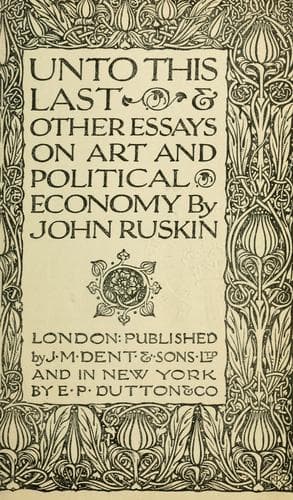
Unto This Last, and Other Essays on Political EconomyRuskin, John
General
Unto This Last, and Other Essays on Political Economy
Ruskin, John
Art; Economics
Labour being thus various in its result, the prosperity of any nation
is in exact proportion to the quantity of labour which it spends in
obtaining and employing means of life. Observe,--I say, obtaining and
employing; that is to say, not merely wisely producing, but wisely
distributing and consuming. Economists usually speak as if there were
no good in consumption absolute.[57] So far from this being so,
consumption absolute is the end, crown, and perfection of production;
and wise consumption is a far more difficult art than wise production.
Twenty people can gain money for one who can use it; and the vital
question, for individual and for nation, is, never "how much do they
make?" but "to what purpose do they spend?"
[57] When Mr. Mill speaks of productive consumption, he only
means consumption which results in increase of capital, or
material wealth. See I. iii. 4, and I. iii. 5.
The reader may, perhaps, have been surprised at the slight reference
I have hitherto made to "capital," and its functions. It is here the
place to define them.
Capital signifies "head, or source, or root material"--it is material
by which some derivative or secondary good is produced. It is only
capital proper (caput vivum, not caput mortuum) when it is thus
producing something different from itself. It is a root, which does
not enter into vital function till it produces something else than a
root; namely, fruit. That fruit will in time again produce roots; and
so all living capital issues in reproduction of capital; but capital
which produces nothing but capital is only root producing root; bulb
issuing in bulb, never in tulip; seed issuing in seed, never in bread.
The Political Economy of Europe has hitherto devoted itself wholly to
the multiplication, or (less even) the aggregation, of bulbs. It never
saw, nor conceived such a thing as a tulip. Nay, boiled bulbs they
might have been--glass bulbs--Prince Rupert's drops, consummated in
powder (well, if it were glass-powder and not gunpowder), for any end
or meaning the economists had in defining the laws of aggregation. We
will try and get a clearer notion of them.
Public-domain text, read in full here on John Shaqi.
Reviews
Reviews
No reviews yet
Be the first to share your thoughts on this work.
Elsewhere in the archive
Join the Discussion
Join the discussion
Sign in to leave a comment or review.
Sign InorCreate an account