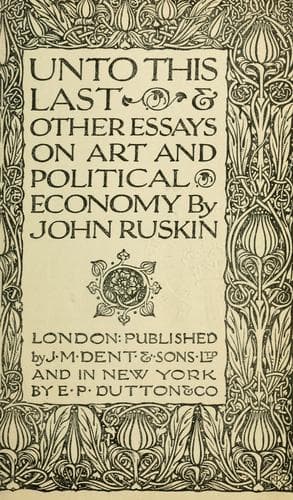
Unto This Last, and Other Essays on Political EconomyRuskin, John
General
Unto This Last, and Other Essays on Political Economy
Ruskin, John
Art; Economics
The best and simplest general type of capital is a well-made
ploughshare. Now, if that ploughshare did nothing but beget other
ploughshares, in a polypous manner,--however the great cluster of
polypous plough might glitter in the sun, it would have lost its
function of capital. It becomes true capital only by another kind of
splendour,--when it is seen "splendescere sulco," to grow bright in
the furrow; rather with diminution of its substance, than addition, by
the noble friction. And the true home question, to every capitalist
and to every nation, is not, "how many ploughs have you?" but, "where
are your furrows?" not--"how quickly will this capital reproduce
itself?"--but, "what will it do during reproduction?" What substance
will it furnish, good for life? what work construct, protective of
life? if none, its own reproduction is useless--if worse than none
(for capital may destroy life as well as support it), its own
reproduction is worse than useless; it is merely an advance from
Tisiphone, on mortgage--not a profit by any means.
Not a profit, as the ancients truly saw, and showed in the type of
Ixion;--for capital is the head, or fountain head, of wealth--the
"well-head" of wealth, as the clouds are the well-heads of rain: but
when clouds are without water, and only beget clouds, they issue in
wrath at last, instead of rain, and in lightning instead of harvest;
whence Ixion is said first to have invited his guests to a banquet,
and then made them fall into a pit filled with fire; which is the type
of the temptation of riches issuing in imprisoned torment,--torment in
a pit (as also Demas' silver mine), after which, to show the rage of
riches passing from lust of pleasure to lust of power, yet power not
truly understood, Ixion is said to have desired Juno, and instead,
embracing a cloud (or phantasm), to have begotten the Centaurs; the
power of mere wealth being, in itself, as the embrace of a
shadow,--comfortless (so also "Ephraim feedeth on wind and followeth
after the east wind"; or "that which is not"--Prov. xxiii. 5; and
again Dante's Geryon, the type of avaricious fraud, as he flies,
gathers the _air_ up with retractile claws,--"l'aer a se
raccolse"[58]), but in its offspring, a mingling of the brutal with
the human nature: human in sagacity--using both intellect and arrow;
but brutal in its body and hoof, for consuming, and trampling down.
For which sin Ixion is at last bound upon a wheel--fiery and toothed,
and rolling perpetually in the air;--the type of human labour when
selfish and fruitless (kept far into the middle ages in their wheel of
fortune); the wheel which has in it no breath or spirit, but is
whirled by chance only; whereas of all true work the Ezekiel vision is
true, that the Spirit of the living creature is in the wheels, and
where the angels go, the wheels go by them; but move no otherwise.
Public-domain text, read in full here on John Shaqi.
Reviews
Reviews
No reviews yet
Be the first to share your thoughts on this work.
Elsewhere in the archive
Join the Discussion
Join the discussion
Sign in to leave a comment or review.
Sign InorCreate an account