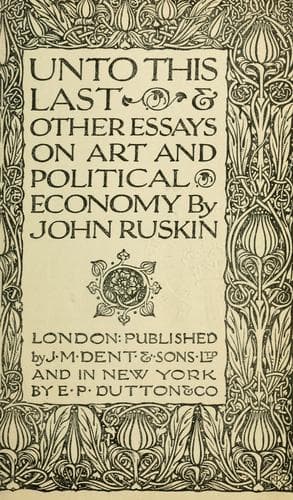
Unto This Last, and Other Essays on Political EconomyRuskin, John
General
Unto This Last, and Other Essays on Political Economy
Ruskin, John
Art; Economics
[58] So also in the vision of the women bearing the ephah, before
quoted, "the wind was in their wings," not wings "of a
stork," as in our version; but "_milvi_," of a kite, in the
Vulgate, or perhaps more accurately still in the Septuagint,
"hoopoe," a bird connected typically with the power of
riches by many traditions, of which that of its petition for
a crest of gold is perhaps the most interesting. The "Birds"
of Aristophanes, in which its part is principal, is full of
them; note especially the "fortification of the air with
baked bricks, like Babylon," l. 550; and, again, compare the
Plutus of Dante, who (to show the influence of riches in
destroying the reason) is the only one of the powers of the
Inferno who cannot speak intelligibly; and also the
cowardliest; he is not merely quelled or restrained, but
literally "collapses" at a word; the sudden and helpless
operation of mercantile panic being all told in the brief
metaphor, "as the sails, swollen with the wind, fall, when
the mast breaks."
This being the real nature of capital, it follows that there are two
kinds of true production, always going on in an active State; one of
seed, and one of food; or production for the Ground, and for the
Mouth; both of which are by covetous persons thought to be production
only for the granary; whereas the function of the granary is but
intermediate and conservative, fulfilled in distribution; else it ends
in nothing but mildew, and nourishment of rats and worms. And since
production for the Ground is only useful with future hope of harvest,
all _essential_ production is for the Mouth; and is finally measured
by the mouth; hence, as I said above, consumption is the crown of
production; and the wealth of a nation is only to be estimated by what
it consumes.
The want of any clear sight of this fact is the capital error, issuing
in rich interest and revenue of error among the political economists.
Their minds are continually set on money-gain, not on mouth-gain; and
they fall into every sort of net and snare, dazzled by the
coin-glitter as birds by the fowler's glass; or rather (for there is
not much else like birds in them) they are like children trying to
jump on the heads of their own shadows; the money-gain being only the
shadow of the true gain, which is humanity.
Public-domain text, read in full here on John Shaqi.
Reviews
Reviews
No reviews yet
Be the first to share your thoughts on this work.
Elsewhere in the archive
Join the Discussion
Join the discussion
Sign in to leave a comment or review.
Sign InorCreate an account