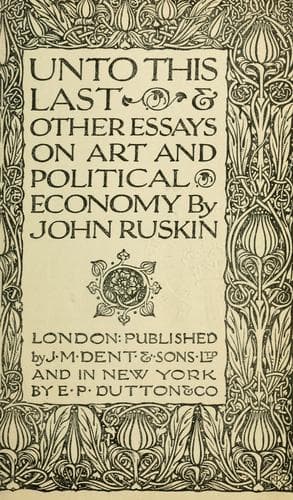
Unto This Last, and Other Essays on Political EconomyRuskin, John
General
Unto This Last, and Other Essays on Political Economy
Ruskin, John
Art; Economics
The final object of political economy, therefore, is to get good
method of consumption, and great quantity of consumption: in other
words, to use everything, and to use it nobly; whether it be
substance, service, or service perfecting substance. The most curious
error in Mr. Mill's entire work (provided for him originally by
Ricardo) is his endeavour to distinguish between direct and indirect
service, and consequent assertion that a demand for commodities is not
demand for labour (I. v. 9, _et seq._). He distinguishes between
labourers employed to lay out pleasure grounds, and to manufacture
velvet; declaring that it makes material difference to the labouring
classes in which of these two ways a capitalist spends his money;
because the employment of the gardeners is a demand for labour, but
the purchase of velvet is not.[59] Error colossal as well as strange.
It will, indeed, make a difference to the labourer whether we bid him
swing his scythe in the spring winds, or drive the loom in
pestilential air; but, so far as his pocket is concerned, it makes to
him absolutely no difference whether we order him to make green
velvet, with seed and a scythe, or red velvet, with silk and scissors.
Neither does it anywise concern him whether, when the velvet is made,
we consume it by walking on it, or wearing it, so long as our
consumption of it is wholly selfish. But if our consumption is to be
in any wise unselfish, not only our mode of consuming the articles we
require interests him, but also the _kind_ of article we require with
a view to consumption. As thus (returning for a moment to Mr. Mill's
great hardware theory[60]): it matters, so far as the labourer's
immediate profit is concerned, not an iron filing whether I employ him
in growing a peach, or forging a bombshell; but my probable mode of
consumption of those articles matters seriously. Admit that it is to
be in both cases "unselfish," and the difference, to him, is final,
whether when his child is ill, I walk into his cottage and give it the
peach, or drop the shell down his chimney, and blow his roof off.
Public-domain text, read in full here on John Shaqi.
Reviews
Reviews
No reviews yet
Be the first to share your thoughts on this work.
Elsewhere in the archive
Join the Discussion
Join the discussion
Sign in to leave a comment or review.
Sign InorCreate an account