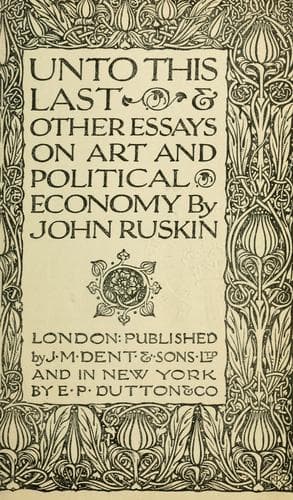
Unto This Last, and Other Essays on Political EconomyRuskin, John
General
Unto This Last, and Other Essays on Political Economy
Ruskin, John
Art; Economics
But if he does deserve it, be sure that you give it him, else you not
only run a chance of driving him from the right road by want of
encouragement, but you deprive yourselves of the happiest privilege
you will ever have of rewarding his labour. For it is only the young
who can receive much reward from men's praise: the old, when they are
great, get too far beyond and above you to care what you think of
them. You may urge them then with sympathy, and surround them then
with acclamation; but they will doubt your pleasure, and despise your
praise. You might have cheered them in their race through the asphodel
meadows of their youth; you might have brought the proud, bright
scarlet into their faces, if you had but cried once to them "Well
done," as they dashed up to the first goal of their early ambition.
But now, their pleasure is in memory, and their ambition is in heaven.
They can be kind to you, but you never more can be kind to them. You
may be fed with the fruit and fullness of their old age, but you were
as the nipping blight to them in their blossoming, and your praise is
only as the warm winds of autumn to the dying branches.
There is one thought still, the saddest of all, bearing on this
withholding of early help. It is possible, in some noble natures, that
the warmth and the affections of childhood may remain unchilled,
though unanswered; and that the old man's heart may still be capable
of gladness, when the long-withheld sympathy is given at last. But in
these noble natures it nearly always happens, that the chief motive of
earthly ambition has not been to give delight to themselves, but to
their parents. Every noble youth looks back, as to the chiefest joy
which this world's honour ever gave him, to the moment when first he
saw his father's eyes flash with pride, and his mother turn away her
head lest he should take her tears for tears of sorrow. Even the
lover's joy, when some worthiness of his is acknowledged before his
mistress, is not so great as that, for it is not so pure--the desire
to exalt himself in her eyes mixes with that of giving her delight;
but he does not need to exalt himself in his parents' eyes: it is
with the pure hope of giving them pleasure that he comes to tell them
what he has done, or what has been said of him; and therefore he has a
purer pleasure of his own. And this purest and best of rewards you
keep from him if you can: you feed him in his tender youth with ashes
and dishonour; and then you come to him, obsequious, but too late,
with your sharp laurel crown, the dew all dried from off its leaves;
and you thrust it into his languid hand, and he looks at you
wistfully. What shall he do with it? What can he do, but go and lay it
on his mother's grave?
Public-domain text, read in full here on John Shaqi.
Reviews
Reviews
No reviews yet
Be the first to share your thoughts on this work.
Join the Discussion
Join the discussion
Sign in to leave a comment or review.
Sign InorCreate an account