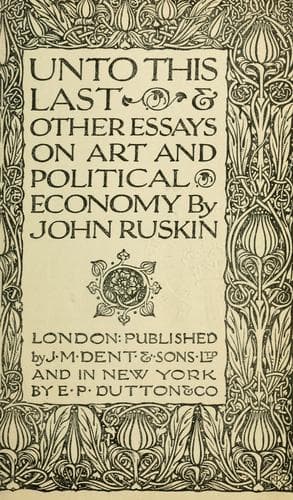
Unto This Last, and Other Essays on Political Economy — John Shaqi
Unto This Last, and Other Essays on Political EconomyRuskin, John
General
Unto This Last, and Other Essays on Political Economy
Ruskin, John
Art; Economics
What we mainly want, therefore, is a means of sufficient and
unagitated employment: not holding out great prizes for which young
painters are to scramble; but furnishing all with adequate support,
and opportunity to display such power as they possess without
rejection or mortification. I need not say that the best field of
labour of this kind would be presented by the constant progress of
public works involving various decoration; and we will presently
examine what kind of public works may thus, advantageously for the
nation, be in constant progress. But a more important matter even than
this of steady employment, is the kind of criticism with which you,
the public, receive the works of the young men submitted to you. You
may do much harm by indiscreet praise and by indiscreet blame; but
remember, the chief harm is always done by blame. It stands to reason
that a young man's work cannot be perfect. It _must_ be more or less
ignorant; it must be more or less feeble; it is likely that it may be
more or less experimental, and if experimental, here and there
mistaken. If, therefore, you allow yourself to launch out into sudden
barking at the first faults you see, the probability is that you are
abusing the youth for some defect naturally and inevitably belonging
to that stage of his progress; and that you might just as rationally
find fault with a child for not being as prudent as a privy
councillor, or with a kitten for not being as grave as a cat. But
there is one fault which you may be quite sure is unnecessary, and
therefore a real and blameable fault: that is haste, involving
negligence. Whenever you see that a young man's work is either bold or
slovenly, then you may attack it firmly; sure of being right. If his
work is bold, it is insolent; repress his insolence: if it is
slovenly, it is indolent; spur his indolence. So long as he works in
that dashing or impetuous way, the best hope for him is in your
contempt: and it is only by the fact of his seeming not to seek your
approbation that you may conjecture he deserves it.
Public-domain text, read in full here on John Shaqi.
Reviews
Reviews
No reviews yet
Be the first to share your thoughts on this work.
Join the Discussion
Join the discussion
Sign in to leave a comment or review.
Sign InorCreate an account