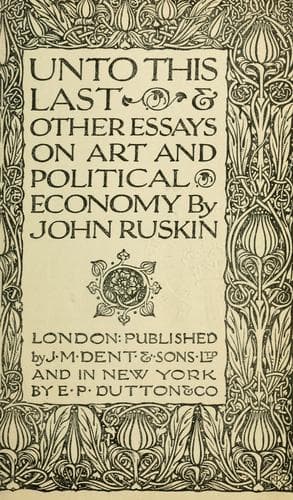
Unto This Last, and Other Essays on Political EconomyRuskin, John
General
Unto This Last, and Other Essays on Political Economy
Ruskin, John
Art; Economics
Respecting riches, the economist has to inquire, first, into the
advisable modes of their collection; secondly, into the advisable
modes of their administration. Respecting the collection of national
riches, he has to inquire, first, whether he is justified in calling
the nation rich; if the quantity of money it possesses relatively to
that possessed by other nations be large, irrespectively of the manner
of its distribution. Or does the mode of distribution in any wise
affect the nature of the riches? Thus, if the king alone be
rich--suppose Croesus or Mausolus--are the Lydians and Carians
therefore a rich nation? Or if one or two slave-masters be rich, and
the nation be otherwise composed of slaves, is it to be called a rich
nation? For if not, and the ideas of a certain mode of distribution
or operation in the riches, and of a certain degree of freedom in the
people, enter into our idea of riches as attributed to a people, we
shall have to define the degree of fluency or circulative character
which is essential to their vitality; and the degree of independence
of action required in their possessors. Questions which look as if
they would take time in answering. And farther. Since there are two
modes in which the inequality, which is indeed the condition and
constituent of riches, may be established--namely, by increase of
possession on the one side, and by decrease of it on the other--we
have to inquire, with respect to any given state of riches, precisely
in what manner the correlative poverty was produced; that is to say,
whether by being surpassed only, or being depressed, what are the
advantages, or the contrary, conceivable in the depression. For
instance, it being one of the commonest advantages of being rich to
entertain a number of servants, we have to inquire, on the one side,
what economical process produced the poverty of the persons who serve
him; and what advantage each (on his own side) derives from the
result.
These being the main questions touching the collection of riches, the
next, or last, part of the inquiry is into their administration.
They have in the main three great economical powers which require
separate examination: namely, the powers of selection, direction, and
provision.
A. Their power of SELECTION relates to things of which the supply is
limited (as the supply of best things is always). When it becomes
matter of question to whom such things are to belong, the richest
person has necessarily the first choice, unless some arbitrary mode of
distribution be otherwise determined upon. The business of the
economist is to show how this choice may be a Wise one.
B. Their power of DIRECTION arises out of the necessary relation of
rich men to poor, which ultimately, in one way or another, involves
the direction of, or authority over, the labour of the poor; and this
nearly as much over their mental as their bodily labour. The business
of the economist is to show how this direction may be a Just one.
Public-domain text, read in full here on John Shaqi.
Reviews
Reviews
No reviews yet
Be the first to share your thoughts on this work.
Elsewhere in the archive
Join the Discussion
Join the discussion
Sign in to leave a comment or review.
Sign InorCreate an account