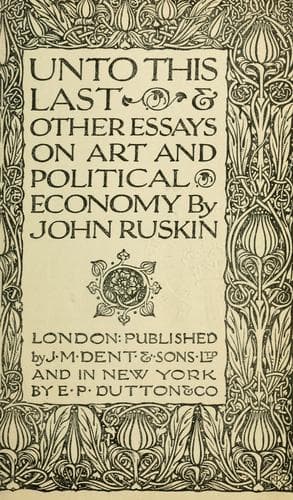
Unto This Last, and Other Essays on Political EconomyRuskin, John
General
Unto This Last, and Other Essays on Political Economy
Ruskin, John
Art; Economics
C. Their power of PROVISION or "preparatory sight" (for pro-accumulation
is by no means necessarily pro-vision), is dependent upon their
redundance; which may of course by active persons be made available
in preparation for future work or future profit; in which function
riches have generally received the name of capital; that is to say, of
head- or source-material. The business of the economist is to show how
this provision may be a Distant one.
The examination of these three functions of riches will embrace every
final problem of political economy;--and, above, or before all, this
curious and vital problem,--whether, since the wholesome action of
riches in these three functions will depend (it appears) on the
Wisdom, Justice, and Far-sightedness of the holders; and it is by no
means to be assumed that persons primarily rich, must therefore be
just and wise,--it may not be ultimately possible so, or somewhat so,
to arrange matters, as that persons primarily just and wise, should
therefore be rich.
Such being the general plan of the inquiry before us, I shall not
limit myself to any consecutive following of it, having hardly any
good hope of being able to complete so laborious a work as it must
prove to me; but from time to time, as I have leisure, shall endeavour
to carry forward this part or that, as may be immediately possible;
indicating always with accuracy the place which the particular essay
will or should take in the completed system.
II.
NATURE OF WEALTH, VARIATIONS OF VALUE, THE NATIONAL STORE, NATURE OF
LABOUR, VALUE AND PRICE, THE CURRENCY.
The last paper having consisted of little more than definition of
terms, I purpose, in this, to expand and illustrate the given
definitions, so as to avoid confusion in their use when we enter into
the detail of our subject.
The view which has been taken of the nature of wealth, namely, that it
consists in an intrinsic value developed by a vital power, is directly
opposed to two nearly universal conceptions of wealth. In the
assertion that value is primarily intrinsic, it opposes the idea that
anything which is an object of desire to numbers, and is limited in
quantity, may be called, or virtually become, wealth. And in the
assertion that value is secondarily dependent upon power in the
possessor, it opposes the idea that wealth consists of things
exchangeable at rated prices. Before going farther, we will make these
two positions clearer.
Public-domain text, read in full here on John Shaqi.
Reviews
Reviews
No reviews yet
Be the first to share your thoughts on this work.
Elsewhere in the archive
Join the Discussion
Join the discussion
Sign in to leave a comment or review.
Sign InorCreate an account