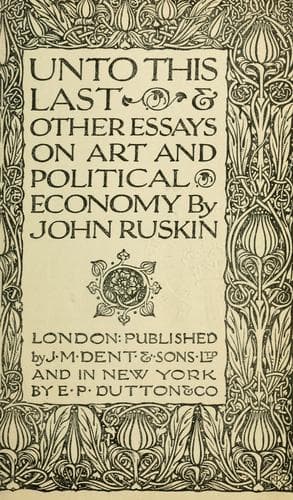
Unto This Last, and Other Essays on Political EconomyRuskin, John
General
Unto This Last, and Other Essays on Political Economy
Ruskin, John
Art; Economics
First. All wealth is intrinsic, and is not constituted by the judgment
of men. This is easily seen in the case of things affecting the body;
we know that no force of fantasy will make stones nourishing, or
poison innocent; but it is less apparent in things affecting the mind.
We are easily--perhaps willingly--misled by the appearance of
beneficial results obtained by industries addressed wholly to the
gratification of fanciful desire; and apt to suppose that whatever is
widely coveted, dearly bought, and pleasurable in possession, must be
included in our definition of wealth. It is the more difficult to quit
ourselves of this error because many things which are true wealth in
moderate use, yet become false wealth in immoderate; and many things
are mixed of good and evil,--as, mostly, books and works of art,--out
of which one person will get the good, and another the evil; so that
it seems as if there were no fixed good or evil in the things
themselves, but only in the view taken, and use made of them. But that
is not so. The evil and good are fixed in essence and in proportion.
They are separable by instinct and judgment, but not interchangeable;
and in things in which evil depends upon excess, the point of excess,
though indefinable, is fixed; and the power of the thing is on the
hither side for good, and on the farther side for evil. And in all
cases this power is inherent, not dependent on opinion or choice. Our
thoughts of things neither make, nor mar their eternal force;
nor--which is the most serious point for future consideration--can
they prevent the effect of it upon ourselves.
Therefore, the object of special analysis of wealth into which we have
presently to enter will be not so much to enumerate what is
serviceable, as to distinguish what is destructive; and to show that
it is inevitably destructive; that to receive pleasure from an evil
thing is not to escape from, or alter the evil of it, but to be
altered by it; that is, to suffer from it to the utmost, having our
own nature, in that degree, made evil also. And it will be shown
farther that, through whatever length of time or subtleties of
connexion the harm is accomplished (being also less or more according
to the fineness and worth of the humanity on which it is wrought),
still, nothing but harm ever comes of a bad thing.
Public-domain text, read in full here on John Shaqi.
Reviews
Reviews
No reviews yet
Be the first to share your thoughts on this work.
Elsewhere in the archive
Join the Discussion
Join the discussion
Sign in to leave a comment or review.
Sign InorCreate an account