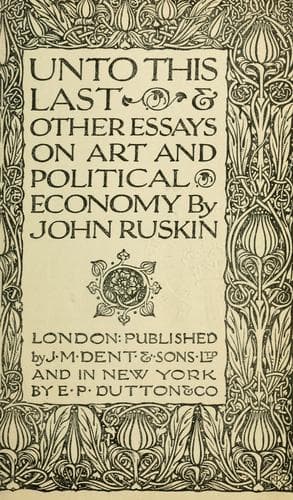
Unto This Last, and Other Essays on Political EconomyRuskin, John
General
Unto This Last, and Other Essays on Political Economy
Ruskin, John
Art; Economics
So that, finally, wealth is not the accidental object of a morbid
desire, but the constant object of a legitimate one.[70] By the fury
of ignorance, and fitfulness of caprice, large interests may be
continually attached to things unserviceable or hurtful; if their
nature could be altered by our passions, the science of Political
Economy would be but as the weighing of clouds, and the portioning out
of shadows. But of ignorance there is no science; and of caprice no
law. Their disturbing forces interfere with the operations of economy,
but have nothing in common with them; the calm arbiter of national
destiny regards only essential power for good in all it accumulates,
and alike disdains the wanderings of imagination and the thirsts of
disease.
[70] Few passages of the Book which at least some part of the
nations at present most advanced in civilization accept as
an expression of final truth, have been more distorted than
those bearing on Idolatry. For the idolatry there denounced
is neither sculpture, nor veneration of sculpture. It is
simply the substitution of an "Eidolon," phantasm, or
imagination of Good, for that which is real and enduring;
from the Highest Living Good, which gives life, to the
lowest material good which ministers to it. The Creator, and
the things created, which He is said to have "seen good" in
creating, are in this their eternal goodness always called
Helpful or Holy: and the sweep and range of idolatry extend
to the rejection of all or any of these, "calling evil good,
or good evil,--putting bitter for sweet, and sweet for
bitter," so betraying the first of all Loyalties, to the
fixed Law of life, and with resolute opposite loyalty
serving our own imagination of good, which is the law, not
of the dwelling, but of the Grave (otherwise called the law
of error; or "mark missing," which we translate law of
"Sin"), these "two masters," between whose services we have
to choose, being otherwise distinguished as God and
"Mammon," which Mammon, though we narrowly take it as the
power of money only, is in truth the great evil spirit of
false and fond desire, or "Covetousness, which is Idolatry."
So that Iconoclasm--image or likeness-breaking--is easy; but
an idol cannot be broken--it must be forsaken, and this is
not so easy, either in resolution or persuasion. For men may
readily be convinced of the weakness of an image, but not of
the emptiness of a phantasm.
Public-domain text, read in full here on John Shaqi.
Reviews
Reviews
No reviews yet
Be the first to share your thoughts on this work.
Elsewhere in the archive
Join the Discussion
Join the discussion
Sign in to leave a comment or review.
Sign InorCreate an account