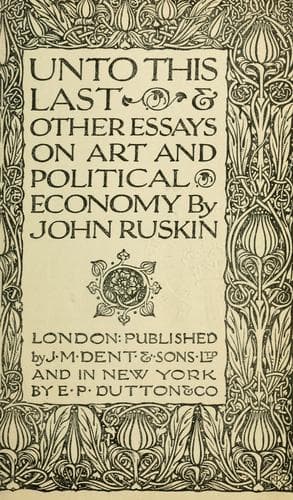
Unto This Last, and Other Essays on Political EconomyRuskin, John
General
Unto This Last, and Other Essays on Political Economy
Ruskin, John
Art; Economics
Secondly. The assertion that wealth is not only intrinsic, but
dependent, in order to become effectual, on a given degree of vital
power in its possessor, is opposed to another popular view of
wealth;--namely, that though it may always be constituted by caprice,
it is, when so constituted, a substantial thing, of which given
quantities may be counted as existing here, or there, and exchangeable
at rated prices.
In this view there are three errors. The first and chief is the
overlooking the fact that all exchangeableness of commodity, or
effective demand for it, depends on the sum of capacity for its use
existing, here or elsewhere. The book we cannot read, or picture we
take no delight in, may indeed be called part of our wealth, in so far
as we have power of exchanging either for something we like better.
But our power of effecting such exchange, and yet more, of effecting
it to advantage, depends absolutely on the number of accessible
persons who can understand the book, or enjoy the painting, and who
will dispute the possession of them. Thus the actual worth of either,
even to us, depends no less on their essential goodness than on the
capacity consisting somewhere for the perception of it; and it is vain
in any completed system of production to think of obtaining one
without the other. So that, though the great political economist knows
that co-existence of capacity for use with temporary possession cannot
be always secured, the final fact, on which he bases all action and
administration, is that, in the whole nation, or group of nations, he
has to deal with, for every grain of intrinsic value produced he must
with exactest chemistry produce its twin grain of governing capacity,
or in the degrees of his failure he has no wealth. Nature's challenge
to us is in earnest, as the Assyrian's mock, "I will give you two
thousand horses, if thou be able on thy part to set riders upon them."
Bavieca's paces are brave, if the Cid backs him; but woe to us, if we
take the dust of capacity, wearing the armour of it, for capacity
itself, for so all procession, however goodly in the show of it, is to
the tomb.
Public-domain text, read in full here on John Shaqi.
Reviews
Reviews
No reviews yet
Be the first to share your thoughts on this work.
Elsewhere in the archive
Join the Discussion
Join the discussion
Sign in to leave a comment or review.
Sign InorCreate an account