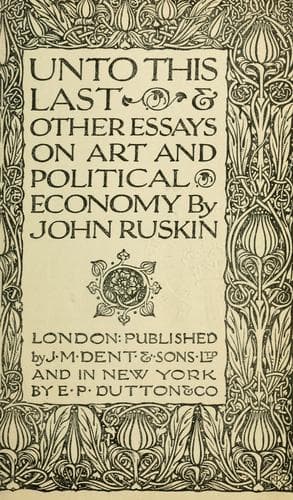
Unto This Last, and Other Essays on Political EconomyRuskin, John
General
Unto This Last, and Other Essays on Political Economy
Ruskin, John
Art; Economics
The second error in this popular view of wealth is that, in estimating
property which we cannot use as wealth, because it is exchangeable, we
in reality confuse wealth with money. The land we have no skill to
cultivate, the book which is sealed to us, or dress which is
superfluous, may indeed be exchangeable, but as such are nothing more
than a cumbrous form of bank-note, of doubtful and slow
convertibility. As long as we retain possession of them, we merely
keep our bank-notes in the shape of gravel or clay, of book leaves, or
of embroidered tissue. Circumstances may perhaps render such forms the
safest, or a certain complacency may attach to the exhibition of
them;--into both these advantages we shall inquire afterwards; I wish
the reader only to observe here, that exchangeable property which we
cannot use is, to us personally, merely one of the forms of money, not
of wealth.
The third error in the popular view is the confusion of guardianship
with possession; the real state of men of property being, too commonly
that of curators, not possessors of wealth. For a man's power of Use,
Administration, Ostentation, Destruction, or Bequest; and possession
is in use only, which for each man is sternly limited; so that such
things, and so much of them, are well for him, or Wealth; and more of
them, or any other things, are ill for him, or Illth. Plunged to the
lips in Orinoco, he shall drink to his thirst measure,--more, at his
peril; with a thousand oxen on his lands, he shall eat to his hunger
measure,--more, at his peril. He cannot live in two houses at once; a
few bales of silk or wool will suffice for the fabric of all the
clothes he can ever wear, and a few books will probably hold all the
furniture good for his brain.[71] Beyond these, in the best of us but
narrow, capacities, we have but the power of administering, or if for
harm, mal-administering, wealth (that is to say, distributing,
lending, or increasing it);--of exhibiting it (as in magnificence of
retinue or furniture), of destroying, or, finally, of bequeathing it.
And with multitudes of rich men, administration degenerates into
curatorship; they merely hold their property in charge, as Trustees,
for the benefit of some person or persons to whom it is to be
delivered upon their death; and the position, explained in clear
terms, would hardly seem a covetable one. What would be the probable
decision of a youth on his entrance into life, to whom the career
hoped for him was proposed in terms such as these: "You must work
unremittingly, and with your utmost intelligence, during all your
available years; you will thus accumulate wealth to a large amount;
but you must touch none of it, beyond what is needful for your
support. Whatever sums you may gain beyond those required for your
decent and moderate maintenance shall be properly taken care of, and
on your death-bed you shall have the power of determining to whom they
shall belong, or to what purposes be applied?"
Public-domain text, read in full here on John Shaqi.
Reviews
Reviews
No reviews yet
Be the first to share your thoughts on this work.
Elsewhere in the archive
Join the Discussion
Join the discussion
Sign in to leave a comment or review.
Sign InorCreate an account