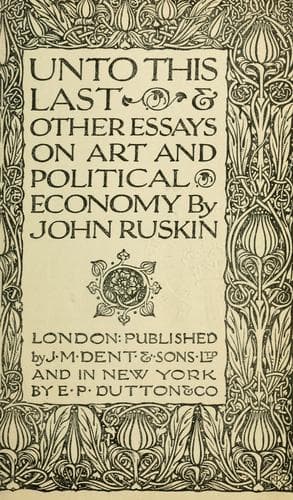
Unto This Last, and Other Essays on Political EconomyRuskin, John
General
Unto This Last, and Other Essays on Political Economy
Ruskin, John
Art; Economics
[83] There is, therefore, observe, no such thing as cheapness
(in the common use of that term), without some error or
injustice. A thing is said to be cheap, not because it is
common, but because it is supposed to be sold under its
worth. Everything has its proper and true worth at any given
time, in relation to everything else; and at that worth
should be bought and sold. If sold under it, it is cheap to
the buyer by exactly so much as the seller loses, and no
more. Putrid meat, at twopence a pound, is not "cheaper"
than wholesome meat at sevenpence a pound; it is probably
much dearer; but if, by watching your opportunity, you can
get the wholesome meat for sixpence a pound, it is cheaper
to you by a penny, which you have gained, and the seller has
lost. The present rage for cheapness is either, therefore,
simply and literally, a rage for badness of all commodities,
or it is an attempt to find persons whose necessities will
force them to let you have more than you should for your
money. It is quite easy to produce such persons, and in
large numbers; for the more distress there is in a nation,
the more cheapness of this sort you can obtain, and your
boasted cheapness is thus merely a measure of the extent of
your national distress.
There is, indeed, a condition of apparent cheapness, which
we confuse, in practice and in reasoning, with the other;
namely, the real reduction in cost of articles by right
application of labour. But in this case the article is only
cheap with reference to its former price, the so-called
cheapness is only our expression for the sensation of
contrast between its former and existing prices. So soon as
the new methods of producing the article are established, it
ceases to be esteemed either cheap or dear, at the new
price, as at the old one, and is felt to be cheap only when
accident enables it to be purchased beneath this new value.
And it is to no advantage to produce the article more
easily, except as it enables you to multiply your
population. Cheapness of this kind is merely the discovery
that more men can be maintained on the same ground; and the
question, how many you will maintain in proportion to your
means, remains exactly in the same terms that it did before.
A form of immediate cheapness results, however, in many
cases, without distress, from the labour of a population
where food is redundant, or where the labour by which the
food is produced leaves much idle time on their hands, which
may be applied to the production of "cheap" articles.
Public-domain text, read in full here on John Shaqi.
Reviews
Reviews
No reviews yet
Be the first to share your thoughts on this work.
Elsewhere in the archive
Join the Discussion
Join the discussion
Sign in to leave a comment or review.
Sign InorCreate an account