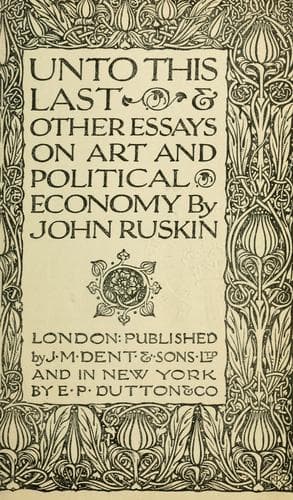
Unto This Last, and Other Essays on Political EconomyRuskin, John
General
Unto This Last, and Other Essays on Political Economy
Ruskin, John
Art; Economics
All such phenomena indicate to the political economist
places where the labour is unbalanced. In the first case,
the just balance is to be effected by taking labourers from
the spot where the pressure exists, and sending them to that
where food is redundant. In the second, the cheapness is a
local accident, advantageous to the local purchaser,
disadvantageous to the local producer. It is one of the
first duties of commerce to extend the market and thus give
the local producer his full advantage.
Cheapness caused by natural accidents of harvest, weather,
etc., is always counterbalanced, in due time, by natural
scarcity similarly caused. It is the part of wise
Government, and healthy commerce, so to provide in times and
places of plenty for times and places of dearth, as that
there shall never be waste, nor famine.
Cheapness caused by gluts of the market is merely a disease
of clumsy and wanton commerce.
But their price is dependent on the human will.
Such and such a thing is demonstrably good for so much. And it may
demonstrably be bad for so much.
But it remains questionable, and in all manner of ways questionable,
whether I choose to give so much.[84]
[84] Price has already been defined (pp. 214, 215) to be the
quantity of labour which the possessor of a thing is willing
to take for it. It is best to consider the price to be that
fixed by the possessor, because the possessor has absolute
power of refusing sale, while the purchaser has no absolute
power of compelling it; but the effectual or market price is
that at which their estimates coincide.
This choice is always a relative one. It is a choice to give a price
for this, rather than for that;--a resolution to have the thing, if
getting it does not involve the loss of a better thing. Price depends,
therefore, not only on the cost of the commodity itself, but on its
relation to the cost of every other attainable thing.
Farther. The power of choice is also a relative one. It depends not
merely on our own estimate of the thing, but on everybody else's
estimate; therefore on the number and force of the will of the
concurrent buyers, and on the existing quantity of the thing in
proportion to that number and force.
Hence the price of anything depends on four variables.[85]
1. Its cost.
2. Its attainable quantity at that cost.
3. The number and power of the persons who want it.
4. The estimate they have formed of its desirableness.
(Its value only affects its price so far as it is contemplated in this
estimate; perhaps, therefore, not at all.)
Public-domain text, read in full here on John Shaqi.
Reviews
Reviews
No reviews yet
Be the first to share your thoughts on this work.
Elsewhere in the archive
Join the Discussion
Join the discussion
Sign in to leave a comment or review.
Sign InorCreate an account