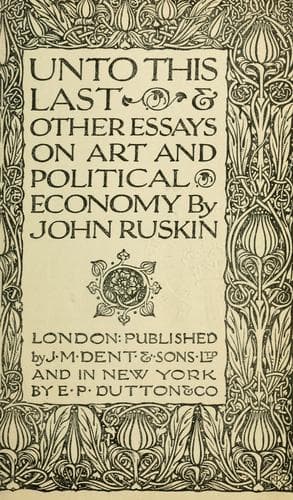
Unto This Last, and Other Essays on Political EconomyRuskin, John
General
Unto This Last, and Other Essays on Political Economy
Ruskin, John
Art; Economics
[85] The two first of these variables are included in the _x_,
and the two last in the _y_, of the formula given at p. 162
of "Unto This Last," and the four are the radical conditions
which regulate the price of things on first production; in
their price in exchange, the third and fourth of these
divide each into two others, forming the Four which are
stated at p. 186 of "Unto This Last."
Now, in order to show the manner in which price is expressed in terms
of a currency, we must assume these four quantities to be known, and
the "estimate of desirableness," commonly called the Demand, to be
certain. We will take the number of persons at the lowest. Let A and B
be two labourers who "demand," that is to say, have resolved to labour
for, two articles, _a_ and _b_. Their demand for these articles (if
the reader likes better, he may say their need) is to be absolute,
existence depending on the getting these two things. Suppose, for
instance, that they are bread and fuel in a cold country, and let _a_
represent the least quantity of bread, and _b_ the least quantity of
fuel, which will support a man's life for a day. Let _a_ be producible
by an hour's labour but _b_ only by two hours' labour; then the cost
of _a_ is one hour, and of _b_ two (cost, by our definition, being
expressible in terms of time). If, therefore, each man worked both for
his corn and fuel, each would have to work three hours a day. But they
divide the labour for its greater ease.[86] Then if A works three
hours, he produces 3_a_, which is one _a_ more than both the men want.
And if B works three hours, he produces only 1-1/2_b_, or half of _b_
less than both want. But if A works three hours and B six, A has 3_a_,
and B has 3_b_, a maintenance in the right proportion for both for a
day and a half; so that each might take a half a day's rest. But as B
has worked double time, the whole of this day's rest belongs in equity
to him. Therefore, the just exchange should be, A, giving two _a_ for
one _b_, has one _a_ and one _b_;--maintenance for a day. B, giving
one _b_ for two _a_, has two _a_ and two _b_;--maintenance for two
days.
[86] This "greater ease" ought to be allowed for by a diminution
in the times of the divided work; but as the proportion of
times would remain the same, I do not introduce this
unnecessary complexity into the calculation.
But B cannot rest on the second day, or A would be left without the
article which B produces. Nor is there any means of making the
exchange just, unless a third labourer is called in. Then one workman,
A, produces _a_, and two, B and C, produce _b_;--A, working three
hours, has three _a_;--B, three hours, 1-1/2_b_;--C, three hours,
1-1/2_b_. B and C each give half of _b_ for _a_, and all have their
equal daily maintenance for equal daily work.
To carry the example a single step farther, let three articles, _a_,
_b_, and _c_, be needed.
Public-domain text, read in full here on John Shaqi.
Reviews
Reviews
No reviews yet
Be the first to share your thoughts on this work.
Elsewhere in the archive
Join the Discussion
Join the discussion
Sign in to leave a comment or review.
Sign InorCreate an account