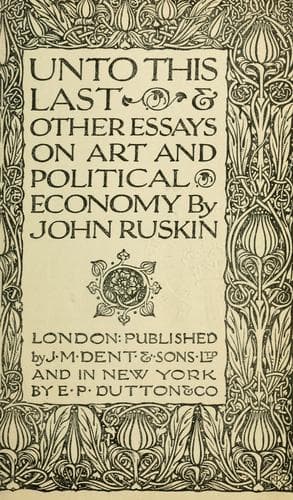
Unto This Last, and Other Essays on Political EconomyRuskin, John
General
Unto This Last, and Other Essays on Political Economy
Ruskin, John
Art; Economics
This weariness of contention is the
chief element of their torture; so marked by the beautiful
lines, beginning, Or puoi, figliuol, etc. (but the usurers,
who made their money inactively, sit on the sand, equally
without rest, however, "Di qua, di la soccorrien," etc.).
For it is not avarice but contention for riches, leading to
this double misuse of them, which, in Dante's sight, is the
unredeemable sin. The place of its punishment is guarded by
Plutus, "the great enemy," and "la fiera crudele," a spirit
quite different from the Greek Plutus, who, though old and
blind, is not cruel, and is curable, so as to become
far-sighted ([Greek: hou typhlos all' oxy blepon]--Plato's
epithets in first book of the Laws). Still more does this
Dantesque type differ from the resplendent Plutus of Goethe
in the second part of "Faust," who is the personified power
of wealth for good or evil; not the passion for wealth; and
again from the Plutus of Spenser, who is the passion of mere
aggregation. Dante's Plutus is specially and definitely the
spirit of Contention and Competition, or Evil Commerce; and
because, as I showed in my last paper, this kind of commerce
"makes all men strangers," his speech is unintelligible, and
no single soul of all those ruined by him has recognizable
features.
(La sconescente vita--
Ad ogni conoscenza or li fa bruni).
On the other hand, the redeemable sins of avarice and
prodigality are, in Dante's sight, those which are without
deliberate or calculated operation. The lust, or lavishness,
of riches can be purged, so long as there has been no
servile consistency of dispute and competition for them. The
sin is spoken of as that of degradation by the love of
earth; it is purified by deeper humiliation--the souls crawl
on their bellies; their chant, "my soul cleaveth unto the
dust." But the spirits here condemned are all recognizable,
and even the worst examples of the thirst for gold, which
they are compelled to tell the histories of during the
night, are of men swept by the passion of avarice into
violent crime, but not sold to its steady work. The precept
given to each of these spirits for its deliverance is--Turn
thine eyes to the lucre (lure) which the Eternal King rolls
with the mighty wheels: otherwise, the wheels of the
"Greater Fortune," of which the constellation is ascending
when Dante's dream begins. Compare George Herbert,--
"Lift up thy head;
Take stars for money; stars, not to be told
By any art, yet to be purchased."
Public-domain text, read in full here on John Shaqi.
Reviews
Reviews
No reviews yet
Be the first to share your thoughts on this work.
Elsewhere in the archive
Join the Discussion
Join the discussion
Sign in to leave a comment or review.
Sign InorCreate an account