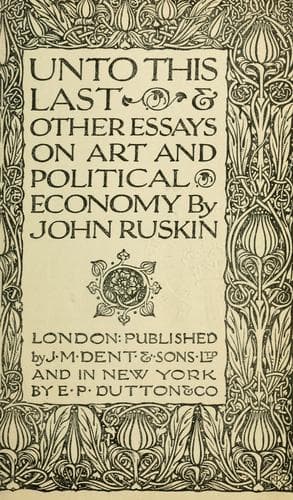
Unto This Last, and Other Essays on Political EconomyRuskin, John
General
Unto This Last, and Other Essays on Political Economy
Ruskin, John
Art; Economics
And Plato's notable sentence in the third book of
"Polity":--"Tell them they have divine gold and silver in
their souls for ever; that they need no money stamped of
men--neither may they otherwise than impiously mingle the
gathering of the divine with the mortal treasure, for
through that which the law of the multitude has coined,
endless crimes have been done and suffered; but in theirs is
neither pollution nor sorrow." At the entrance of this place
of punishment an evil spirit is seen by Dante, quite other
than the "Gran Nemico." The great enemy is obeyed knowingly
and willingly; but this spirit--feminine--and called a
Siren--is the "Deceitfulness of riches," [Greek: apate
ploutou] of the gospels, winning obedience by guile. This is
the Idol of Riches, made doubly phantasmal by Dante's seeing
her in a dream. She is lovely to look upon, and enchants by
her sweet singing, but her womb is loathsome. Now, Dante
does not call her one of the Sirens carelessly, any more
than he speaks of Charybdis carelessly, and though he had
only got at the meaning of the Homeric fable through
Virgil's obscure tradition of it, the clue he has given us
is quite enough. Bacon's interpretation, "the Sirens, or
pleasures," which has become universal since his time, is
opposed alike to Plato's meaning and Homer's. The Sirens are
not pleasures, but Desires: in the Odyssey they are the
phantoms of vain desire; but in Plato's vision of Destiny,
phantoms of constant Desire; singing each a different note
on the circles of the distaff of Necessity, but forming one
harmony, to which the three great Fates put words. Dante,
however, adopted the Homeric conception of them, which was
that they were demons of the Imagination, not carnal (desire
of the eyes; not lust of the flesh); therefore said to be
daughters of the Muses. Yet not of the muses, heavenly or
historical, but of the muse of pleasure; and they are at
first winged, because even vain hope excites and helps when
first formed; but afterwards, contending for the possession
of the imagination with the muses themselves, they are
deprived of their wings, and thus we are to distinguish the
Siren power from the Power of Circe, who is no daughter of
the muses, but of the strong elements, Sun and Sea; her
power is that of frank and full vital pleasure, which, if
governed and watched, nourishes men; but, unwatched, and
having no "moly," bitterness or delay mixed with it, turns
men into beasts, but does not slay them, leaves them, on the
contrary, power of revival. She is herself indeed an
Enchantress;--pure Animal life; transforming--or
Public-domain text, read in full here on John Shaqi.
Reviews
Reviews
No reviews yet
Be the first to share your thoughts on this work.
Elsewhere in the archive
Join the Discussion
Join the discussion
Sign in to leave a comment or review.
Sign InorCreate an account