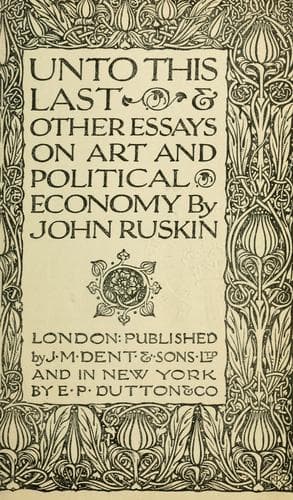
Unto This Last, and Other Essays on Political EconomyRuskin, John
General
Unto This Last, and Other Essays on Political Economy
Ruskin, John
Art; Economics
[102] While I have traced the finer and higher laws of this matter
for those whom they concern, I have also to note the
material law--vulgarly expressed in the proverb, "Honesty is
the best policy." That proverb is indeed wholly inapplicable
to matters of private interest. It is not true that honesty,
as far as material gain is concerned, profits individuals. A
clever and cruel knave will, in a mixed society, always be
richer than an honest person can be. But Honesty is the best
"policy," if policy means practice of State. For fraud gains
nothing in a State. It only enables the knaves in it to live
at the expense of honest people; while there is for every
act of fraud, however small, a loss of wealth to the
community. Whatever the fraudulent person gains, some other
person loses, as fraud produces nothing; and there is,
besides, the loss of the time and thought spent in
accomplishing the fraud; and of the strength otherwise
obtainable by mutual help (not to speak of the fevers of
anxiety and jealousy in the blood, which are a heavy
physical loss, as I will show in due time). Practically,
when the nation is deeply corrupt, cheat answers to cheat,
every one is in turn imposed upon, and there is to the body
politic the dead loss of ingenuity, together with the
incalculable mischief of the injury to each defrauded
person, producing collateral effect unexpectedly. My
neighbour sells me bad meat: I sell him in return flawed
iron. We neither of us get one atom of pecuniary advantage
on the whole transaction, but we both suffer unexpected
inconvenience;--my men get scurvy, and his cattle-truck runs
off the rails.
Farther still. As Charis becomes Charitas on the one side, she
becomes--better still--Chara, Joy, on the other; or rather this is her
very mother's milk and the beauty of her childhood; for God brings no
enduring Love, nor any other good, out of pain, nor out of contention;
but out of joy and harmony.[103] And in this sense, human and divine,
music and gladness, and the measures of both, come into her name; and
Cher becomes full-vowelled Cheer, and Cheerful; and Chara,
companioned, opens into Choir and Choral.
[103] "[Greek: ta men houn alla zoa ouk echein aisthesin ton
en tais kinesesi taxeon oude ataxion, hoi de rhuthmos
onoma kai harmonia hemin de ous eipomen tous theous]
[Apollo, the Muses, and Bacchus--the grave Bacchus, that
is---ruling the choir of age; or Bacchus restraining;
'saeva _tene_, cum Berecyntio cornu, tympana,' etc.]
[Greek: sunchoreutas dedosthai, toutous einai kai tous
dedokotas ten enruthmon te kai henarmonion aisthesin
meth' edones ... chorous te onomakenai para tes charas
emphyton unoma.]"--"Laws," book ii.
Public-domain text, read in full here on John Shaqi.
Reviews
Reviews
No reviews yet
Be the first to share your thoughts on this work.
Elsewhere in the archive
Join the Discussion
Join the discussion
Sign in to leave a comment or review.
Sign InorCreate an account