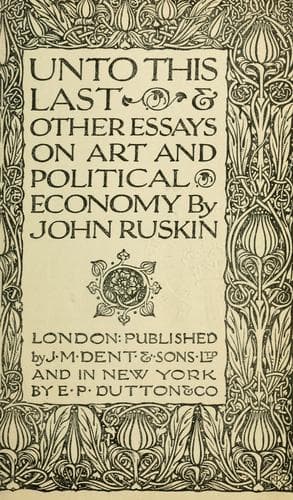
Unto This Last, and Other Essays on Political EconomyRuskin, John
General
Unto This Last, and Other Essays on Political Economy
Ruskin, John
Art; Economics
And lastly. As Grace passes into Freedom of action, Charis becomes
Eleutheria, or liberality; a form of liberty quite curiously and
intensely different from the thing usually understood by "Liberty"
in modern language; indeed, much more like what some people would
call slavery; for a Greek always understood, primarily, by liberty,
deliverance from the law of his own passions (or from what the
Christian writers call bondage of corruption), and this a complete
liberty: not having to resist the passion, but making it fawn upon,
and follow him--(this may be again partly the meaning of the fawning
beasts about the Circean cave; so, again, George Herbert--
Correct thy passion's spite;
Then may the beasts draw thee to happy light)--
not being merely safe from the Siren, but also unbound from the mast.
And it is only in such generosity that any man becomes capable of so
governing others as to take true part in any system of national
economy. Nor is there any other eternal distinction between the upper
and lower classes than this form of liberty, Eleutheria, or benignity,
in the one, and its opposite of slavery, Douleia, or malignity, in the
other; the separation of these two orders of men, and the firm
government of the lower by the higher, being the first conditions of
possible wealth and economy in any state,--the Gods giving it no
greater gift than the power to discern its freemen, and "malignum
spernere vulgus."
The examination of this form of Charis must, therefore, lead us into
the discussion of the principles of government in general, and
especially of that of the poor by the rich, discovering how the
Graciousness joined with the Greatness, or Love with Majestas, is the
true Dei Gratia, or Divine Right, of every form and manner of King;
_i.e._, specifically, of the thrones, dominations, princedoms,
virtues, and powers of the earth;--of the thrones, stable, or
"ruling," literally right-doing powers ("rex eris, recte si facies:")
of the dominations, lordly, edifying, dominant, and harmonious powers;
chiefly domestic, over the "built thing," domus, or house; and
inherently twofold, Dominus and Domina; Lord and Lady: of the
Princedoms, pre-eminent, incipient, creative, and demonstrative
powers; thus poetic and mercantile, in the "princeps carmen deduxisse"
and the merchant-prince: of the Virtues or Courages; militant,
guiding, or Ducal powers; and finally of the Strengths and Forces
pure; magistral powers, of the more over the less, and the forceful
and free over the weak and servile elements of life.
Subject enough for the next paper involving "economical" principles of
some importance, of which, for theme, here is a sentence, which I do
not care to translate, for it would sound harsh in English, though,
truly, it is one of the tenderest ever uttered by man; which may be
meditated over, or rather through, in the meanwhile, by any one who
will take the pains:--
Public-domain text, read in full here on John Shaqi.
Reviews
Reviews
No reviews yet
Be the first to share your thoughts on this work.
Elsewhere in the archive
Join the Discussion
Join the discussion
Sign in to leave a comment or review.
Sign InorCreate an account