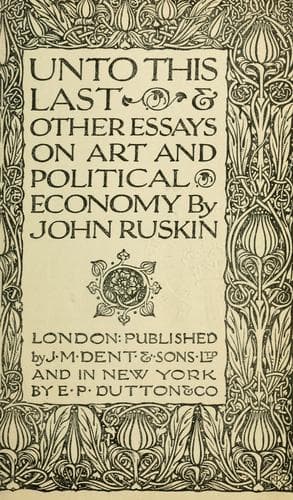
Unto This Last, and Other Essays on Political EconomyRuskin, John
General
Unto This Last, and Other Essays on Political Economy
Ruskin, John
Art; Economics
[Greek: Arh oun, hosper hippos to anepistemoni men encheirounti
de chresthai zemia estin, houto kai adelphos hotan tis auto me
epistamenos encheire chresthai, zemia esti?]
IV.
LAWS AND GOVERNMENTS: LABOUR AND RICHES.
It remains, in order to complete the series of our definitions, that
we examine the general conditions of government, and fix the sense in
which we are to use, in future, the terms applied to them.
The government of a state consists in its customs, laws, and councils,
and their enforcements.
I.--CUSTOMS.
As one person primarily differs from another by fineness of nature,
and secondarily, by fineness of training, so also, a polite nation
differs from a savage one, first by the refinement of its nature, and
secondly by the delicacy of its customs.
In the completeness, or accomplishment of custom, which is the
nation's self-government, there are three stages--first, fineness in
method of doing or of being;--called the manner or moral of acts:
secondly, firmness in holding such method after adoption, so that
it shall become a habit in the character: _i.e._, a constant "having"
or "behaving"; and, lastly, practice, or ethical power in performance
and endurance, which is the skill following on habit, and the ease
reached by frequency of right doing.
The sensibility of the nation is indicated by the fineness of its
customs; its courage, patience, and temperance by its persistence in
them.
By sensibility I mean its natural perception of beauty, fitness, and
rightness; or of what is lovely, decent, and just: faculties
dependent much on race, and the primal signs of fine breeding in man;
but cultivable also by education, and necessary perishing without it.
True education has, indeed, no other function than the development of
these faculties, and of the relative will. It has been the great error
of modern intelligence to mistake science for education. You do not
educate a man by telling him what he knew not, but by making him what
he was not.
And making him what he will remain for ever: for no wash of weeds will
bring back the faded purple. And in that dyeing there are two
processes--first, the cleansing and wringing out, which is the baptism
with water; and then the infusing of the blue and scarlet colours,
gentleness and justice, which is the baptism with fire.
The customs and manners of a sensitive and highly-trained race are
always vital: that is to say, they are orderly manifestations of
intense life (like the habitual action of the fingers of a musician).
The customs and manners of a vile and rude race, on the contrary,
are conditions of decay: they are not, properly speaking, habits,
but incrustations; not restraints, or forms, of life; but
gangrenes;--noisome, and the beginnings of death. And generally, so
far as custom attaches itself to indolence instead of action, and to
prejudice instead of perception, it takes this deadly character, so
that thus
Public-domain text, read in full here on John Shaqi.
Reviews
Reviews
No reviews yet
Be the first to share your thoughts on this work.
Elsewhere in the archive
Join the Discussion
Join the discussion
Sign in to leave a comment or review.
Sign InorCreate an account