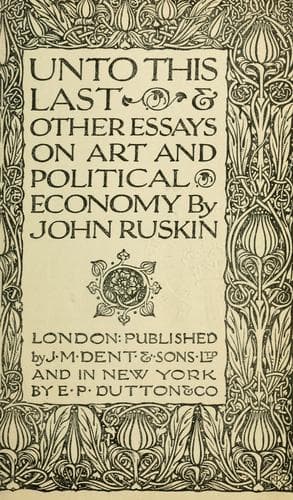
Unto This Last, and Other Essays on Political EconomyRuskin, John
General
Unto This Last, and Other Essays on Political Economy
Ruskin, John
Art; Economics
Also, it is necessary to keep clearly in view the distinction between
these two kinds of law, because the possible range of law is wider in
proportion to their separation. There are many points of conduct
respecting which the nation may wisely express its will by a written
precept or resolve; yet not enforce it by penalty; and the expedient
degree of penalty is always quite a separate consideration from the
expedience of the statute, for the statute may often be better
enforced by mercy than severity, and is also easier in bearing, and
less likely to be abrogated. Farther, laws of precept have reference
especially to youth, and concern themselves with training; but laws of
judgment to manhood, and concern themselves with remedy and reward.
There is a highly curious feeling in the English mind against
educational law; we think no man's liberty should be interfered with
till he has done irrevocable wrong; whereas it is then just too late
for the only gracious and kingly interference, which is to hinder him
from doing it. Make your educational laws strict, and your criminal
ones may be gentle; but, leave youth its liberty, and you will have to
dig dungeons for age. And it is good for a man that he wear the yoke
in his youth; for the yoke of youth, if you know how to hold it, may
be of silken thread; and there is sweet chime of silver bells at that
bridle rein; but, for the captivity of age, you must forge the iron
fetter, and cast the passing bell.
Since no law can be in a final or true sense established, but by right
(all unjust laws involving the ultimate necessity of their own
abrogation), the law-sustaining power in so far as it is Royal, or
"right doing";--in so far, that is, as it rules, not mis-rules, and
orders, not dis-orders, the things submitted to it. Throned on this
rock of justice, the kingly power becomes established and
establishing, "[Greek: theios]," or divine, and, therefore, it is
literally true that no ruler can err, so long as he is a ruler, or
[Greek: archon oudeis hamartanei tote hotan archon e] (perverted by
careless thought, which has cost the world somewhat, into "the king
can do no wrong"). Which is a divine right of kings indeed, and quite
unassailable, so long as the terms of it are "God and my Right," and
not "Satan and my Wrong," which is apt, in some coinages, to appear on
the reverse of the die, under a good lens.
Meristic law, or that of tenure of property, first determines what
every individual possesses by right, and secures it to him; and what
he possesses by wrong, and deprives him of it. But it has a far higher
provisory function: it determines what every man should possess, and
puts it within his reach on due conditions; and what he should not
possess, and puts this out of his reach conclusively.
Public-domain text, read in full here on John Shaqi.
Reviews
Reviews
No reviews yet
Be the first to share your thoughts on this work.
Elsewhere in the archive
Join the Discussion
Join the discussion
Sign in to leave a comment or review.
Sign InorCreate an account