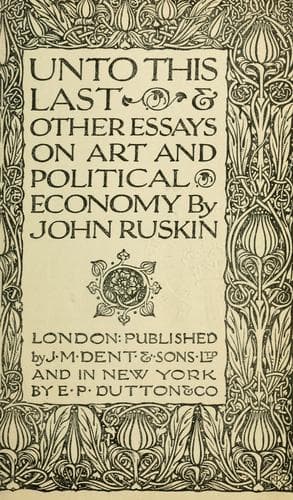
Unto This Last, and Other Essays on Political EconomyRuskin, John
General
Unto This Last, and Other Essays on Political Economy
Ruskin, John
Art; Economics
So also the terms "republic" and "democracy" are confused, especially
in modern use; and both of them are liable to every sort of
misconception. A republic means, properly, a polity in which the
state, with its all, is at every man's service, and every man, with
his all, at the state's service (people are apt to lose sight of the
last condition); but its government may nevertheless be oligarchic
(consular, or decemviral, for instance), or monarchic (dictatorial).
But a democracy means a state in which the government rests directly
with the majority of the citizens. And both these conditions have been
judged only by such accidents and aspects of them as each of us has
had experience of; and sometimes both have been confused with anarchy,
as it is the fashion at present to talk of the "failure of republican
institutions in America," when there has never yet been in America any
such thing as an institution; neither any such thing as a res-publica,
but only a multitudinous res-privata; every man for himself. It is not
republicanism which fails now in America; it is your model science of
political economy, brought to its perfect practice. There you may see
competition, and the "law of demand and supply" (especially in paper),
in beautiful and unhindered operation.[111] Lust of wealth, and trust
in it; vulgar faith in magnitude and multitude, instead of nobleness;
besides that faith natural to backwoodsmen,--"lucum ligna,"--perpetual
self-contemplation, issuing in passionate vanity: total ignorance of
the finer and higher arts, and of all that they teach and bestow;[112]
and the discontent of energetic minds unoccupied, frantic with hope of
uncomprehended change, and progress they know not whither;[113] these
are the things that they have "failed" with in America; and yet not
altogether failed--it is not collapse, but collision; the greatest
railroad accident on record, with fire caught from the furnace, and
Catiline's quenching "non aqua, sed ruina." But I see not, in any of
our talk of them, justice enough done to their erratic strength of
purpose, nor any estimate taken of the strength of endurance of
domestic sorrow in what their women and children suppose a righteous
cause. And out of that endurance and suffering, its own fruit will be
born with time; and Carlyle's prophecy of them (June, 1850), as it has
now come true in the first clause, will in the last.
Public-domain text, read in full here on John Shaqi.
Reviews
Reviews
No reviews yet
Be the first to share your thoughts on this work.
Elsewhere in the archive
Join the Discussion
Join the discussion
Sign in to leave a comment or review.
Sign InorCreate an account