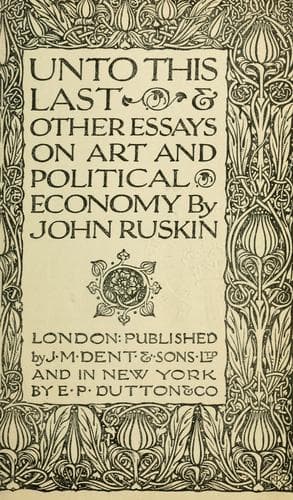
Unto This Last, and Other Essays on Political EconomyRuskin, John
General
Unto This Last, and Other Essays on Political Economy
Ruskin, John
Art; Economics
America too will find that caucuses, division-lists,
stump-oratory and speeches to Buncombe will _not_ carry men
to the immortal gods; that the Washington Congress, and
constitutional battle of Kilkenny cats is, there as here,
naught for such objects; quite incompetent for such; and, in
fine, that said sublime constitutional arrangement will
require to be (with terrible throes, and travail such as few
expect yet) remodelled, abridged, extended, suppressed; torn
asunder, put together again;--not without heroic labour, and
effort quite other than that of the Stump-Orator and the
Revival Preacher, one day!
[111] "Supply-and-demand,--alas! For what noble work was there
ever any audible 'demand' in that poor sense?" ("Past and
Present"). Nay, the demand is not loud even for ignoble
work. See "Average earnings of Betty Taylor," in _Times_, of
4th February, of this year [1863]: "Worked from Monday
morning at 8 a.m., to Friday night at 5.30 p.m., for 1_s._
5-1/2_d._"--Laissez faire.
[112] See Bacon's note in the "Advancement of Learning," on
"didicisse fideliter artes" (but indeed the accent had need
be upon "fideliter"). "It taketh away vain admiration of
anything, which is the root of all weakness: for all things
are admired either because they are new, or because they are
great," etc.
[113] Ames, by report of Waldo Emerson, expressed the popular
security wisely, saying, "that a monarchy is a merchantman,
which sails well, but will sometimes strike on a rock, and
go to the bottom; whilst a republic is a raft, which would
never sink, but then your feet are always in the water."
Yes, and when the four winds (your only pilots) steer
competitively from the four corners, [Greek: hos d' hot'
oporinos Borees phoreesin akanthas], perhaps the wiser
mariner may wish for keel and wheel again.
Understand, then, once for all, that no form of government, provided
it be a government at all, is, as such, either to be condemned or
praised, or contested for in anywise but by fools. But all forms of
government are good just so far as they attain this one vital
necessity of policy--that the wise and kind, few or many, shall govern
the unwise and unkind; and they are evil so far as they miss of this
or reverse it. Nor does the form in any case signify one whit, but its
firmness and adaptation to the need; for if there be many foolish
persons in a state, and few wise, then it is good that the few govern;
and if there be many wise and few foolish, then it is good that many
govern; and if many be wise, yet one wiser, then it is good that one
should govern; and so on. Thus, we may have "the ants' republic, and
the realm of bees," both good in their kind; one for groping, and the
other for building; and nobler still, for flying, the Ducal monarchy
of those
Public-domain text, read in full here on John Shaqi.
Reviews
Reviews
No reviews yet
Be the first to share your thoughts on this work.
Elsewhere in the archive
Join the Discussion
Join the discussion
Sign in to leave a comment or review.
Sign InorCreate an account