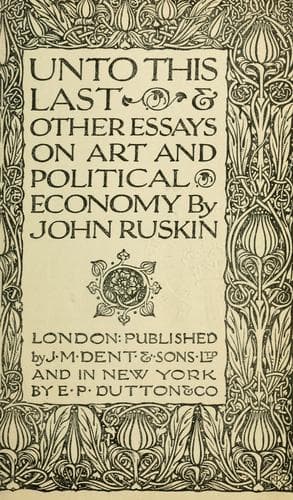
Unto This Last, and Other Essays on Political EconomyRuskin, John
General
Unto This Last, and Other Essays on Political Economy
Ruskin, John
Art; Economics
Now, as you will have anticipated, I am going to address you, on this
and our succeeding evening, chiefly on the subject of that economy
which relates rather to the garden than the farm-yard. I shall ask you
to consider with me the kind of laws by which we shall best distribute
the beds of our national garden, and raise in it the sweetest
succession of trees pleasant to the sight, and (in no forbidden sense)
to be desired to make us wise. But, before proceeding to open this
specialty of our subject, let me pause for a few moments to plead with
you for the acceptance of that principle of government or authority
which must be at the root of all economy, whether for use or for
pleasure. I said, a few minutes ago, that a nation's labour, well
applied, was amply sufficient to provide its whole population with
good food, comfortable clothing, and pleasant luxury. But the good,
instant, and constant application is everything. We must not, when our
strong hands are thrown out of work, look wildly about for want of
something to do with them. If ever we feel that want, it is a sign
that all our household is out of order. Fancy a farmer's wife, to whom
one or two of her servants should come at twelve o'clock at noon,
crying that they had got nothing to do; that they did not know what to
do next: and fancy still farther, the said farmer's wife looking
hopelessly about her rooms and yard, they being all the while
considerably in disorder, not knowing where to set the spare
hand-maidens to work, and at last complaining bitterly that she had
been obliged to give them their dinner for nothing. That's the type of
the kind of political economy we practise too often in England. Would
you not at once assert of such a mistress that she knew nothing of her
duties? and would you not be certain, if the household were rightly
managed, the mistress would be only too glad at any moment to have the
help of any number of spare hands; that she would know in an instant
what to set them to;--in an instant what part of to-morrow's work
might be most serviceably forwarded, what part of next month's work
most wisely provided for, or what new task of some profitable kind
undertaken? and when the evening came, and she dismissed her servants
to their recreation or their rest, or gathered them to the reading
round the work-table, under the eaves in the sunset, would you not be
sure to find that none of them had been overtasked by her, just
because none had been left idle; that everything had been accomplished
because all had been employed; that the kindness of the mistress had
aided her presence of mind, and the slight labour had been entrusted
to the weak, and the formidable to the strong; and that as none had
been dishonoured by inactivity so none had been broken by toil?
Public-domain text, read in full here on John Shaqi.
Reviews
Reviews
No reviews yet
Be the first to share your thoughts on this work.
Join the Discussion
Join the discussion
Sign in to leave a comment or review.
Sign InorCreate an account