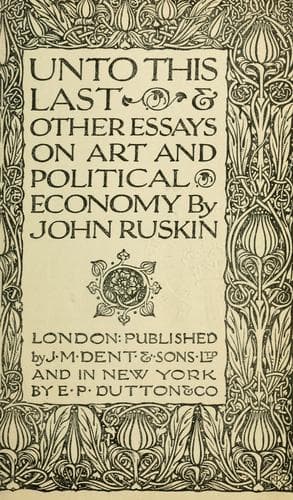
Unto This Last, and Other Essays on Political EconomyRuskin, John
General
Unto This Last, and Other Essays on Political Economy
Ruskin, John
Art; Economics
[21] I have given the political economists too much credit in
saying this. Actually, while these sheets are passing
through the press, the blunt, broad, unmitigated fallacy is
enunciated, formally and precisely, by the Common Councilmen
of New York, in their report on the present commercial
crisis. Here is their collective opinion, published in the
_Times_ of November 23rd, 1857:--"Another erroneous idea is
that luxurious living, extravagant dressing, splendid
turn-outs and fine houses, are the cause of distress to a
nation. No more erroneous impression could exist. Every
extravagance that the man of 100,000 or 1,000,000 dollars
indulges in adds to the means, the support, the wealth of
ten or a hundred who had little or nothing else but their
labour, their intellect, or their taste. If a man of
1,000,000 dollars spends principal and interest in ten
years, and finds himself beggared at the end of that time,
he has actually made a hundred who have catered to his
extravagance, employers or employed, so much richer by the
division of his wealth. He may be ruined, but the nation is
better off and richer, for one hundred minds and hands, with
10,000 dollars apiece, are far more productive than one with
the whole."
Yes, gentlemen of the Common Council! but what has been
doing in the time of the transfer? The spending of the
fortune has taken a certain number of years (suppose ten),
and during that time 1,000,000 dollars' worth of work has
been done by the people, who have been paid that sum for it.
Where is the product of that work? By your own statement,
wholly consumed; for the man for whom it has been done is
now a beggar. You have given, therefore, as a nation,
1,000,000 dollars' worth of work, and ten years of time, and
you have produced, as ultimate result, one beggar! Excellent
economy, gentlemen! and sure to conduce, in due sequence, to
the production of _more_ than one beggar. Perhaps the matter
may be made clearer to you, however, by a more familiar
instance. If a schoolboy goes out in the morning with five
shillings in his pocket, and comes home at night penniless,
having spent his all in tarts; principal and interest are
gone, and fruiterer and baker are enriched. So far so good.
But suppose the schoolboy, instead, has bought a book and a
knife; principal and interest are gone, and bookseller and
cutler are enriched. But the schoolboy is enriched also, and
may help his schoolfellows next day with knife and book,
instead of lying in bed and incurring a debt to the doctor.
Public-domain text, read in full here on John Shaqi.
Reviews
Reviews
No reviews yet
Be the first to share your thoughts on this work.
Elsewhere in the archive
Join the Discussion
Join the discussion
Sign in to leave a comment or review.
Sign InorCreate an account