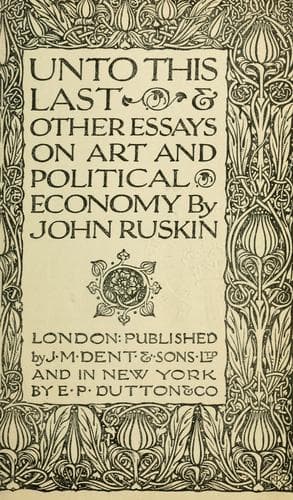
Unto This Last, and Other Essays on Political EconomyRuskin, John
General
Unto This Last, and Other Essays on Political Economy
Ruskin, John
Art; Economics
The enervating influence of luxury, and its tendencies to increase
vice, are points which I keep entirely out of consideration in the
present essay; but, so far as they bear on any question discussed,
they merely furnish additional evidence on the side which I have
taken. Thus, in the present case, I assume that the luxuries of
civilized life are in possession harmless, and in acquirement,
serviceable as a motive for exertion; and even on these favourable
terms, we arrive at the conclusion that the nation ought not to
indulge in them except under severe limitations. Much less ought it to
indulge in them if the temptation consequent on their possession, or
fatality incident to their manufacture, more than counterbalances the
good done by the effort to obtain them.
Note 6th, p. 48.--"_Economy of Literature._"
I have been much impressed lately by one of the results of the
quantity of our books; namely, the stern impossibility of getting
anything understood, that required patience to understand. I observe
always, in the case of my own writings, that if ever I state anything
which has cost me any trouble to ascertain, and which, therefore, will
probably require a minute or two of reflection from the reader before
it can be accepted,--that statement will not only be misunderstood,
but in all probability taken to mean something very nearly the reverse
of what it does mean. Now, whatever faults there may be in my modes of
expression, I know that the words I use will always be found, by
Johnson's dictionary, to bear, first of all, the sense I use them in;
and that the sentences, whether awkwardly turned or not, will, by the
ordinary rules of grammar, bear no other interpretation than that I
mean them to bear; so that the misunderstanding of them must result,
ultimately, from the mere fact that their matter sometimes requires a
little patience. And I see the same kind of misinterpretation put on
the words of other writers, whenever they require the same kind of
thought.
I was at first a little despondent about this; but, on the whole, I
believe it will have a good effect upon our literature for some time
to come; and then, perhaps, the public may recover its patience again.
For certainly it is excellent discipline for an author to feel that he
must say all he has to say in the fewest possible words, or his reader
is sure to skip them; and in the plainest possible words, or his
reader will certainly misunderstand them. Generally, also, a downright
fact may be told in a plain way; and we want downright facts at
present more than any thing else. And though I often hear moral people
complaining of the bad effects of want of thought, for my part, it
seems to me that one of the worst diseases to which the human creature
is liable is its disease of thinking. If it would only just _look_[22]
at a thing instead of thinking what it must be like, or _do_ a thing,
instead of thinking it cannot be done, we should all get on far
better.
Public-domain text, read in full here on John Shaqi.
Reviews
Reviews
No reviews yet
Be the first to share your thoughts on this work.
Elsewhere in the archive
Join the Discussion
Join the discussion
Sign in to leave a comment or review.
Sign InorCreate an account