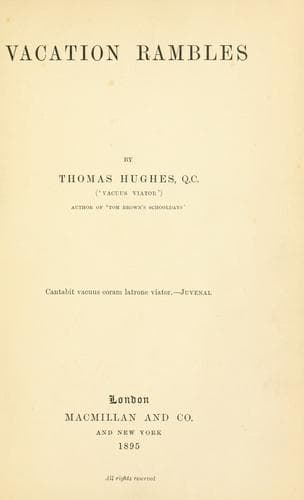
Europe -- Description and travel; United States -- Description and travel
As the Land’s End light receded, we became aware of another light away
some twenty miles to the south-west. It is on a rock not fifty yards
across, the Captain says, at high tide, and often unapproachable
for weeks together--“The Hawk,” by name, on which are kept four
lighthouse-men, who spend there alternate months, weather permitting.
I was glad to hear that there are four at a time, as the sight of “The
Hawk” brought vividly to my mind the gruesome story of fifty years back,
when there were only two men, who were known not to be good friends. One
died, and his companion had to wait with the dead body for weeks before
his relief came.
I noticed, before we were two hours out, that there was something
unusually smart about the crew, quite what one would look for on the
_Umbria_ or _Germanic_, but scarcely on a 700-tons cargo-boat plying to
Bordeaux. Several of the young hands were fine British tars, with the
splendid throats and great muscular hands and wrists which stand out so
well from the blue woollen jerseys; but the one who struck me most was
the ship’s carpenter, a gray, weather-beaten old salt, who was going
round quietly, but all the time with his broad-headed hammer, setting
little things straight, helping to straighten the tarpaulins over the
hatches and deck-cargo, and sounding the well. I caught him now and then
for a few words, as he passed my deck-chair, and got the clue. Most of
the crew were Naval Reserve men, and followed the Captain, a lieutenant
in the R.N.R., who could fly the blue ensign in foreign ports, which
they liked. Besides, he was a skipper who cared for his men, looked
after their mess and berths, and never wanted to make anything out of
them; charged them only a shilling a pound for their baccy, the price at
which he could get it out of bond, while most skippers charged 2s. 6d.,
the shop price. He had come to this boat while his big ship was laid
up in dock, to oblige the owners, so they had followed him. Besides,
he never put them to any work he wouldn’t bear a hand in; had stood for
hours up to his waist last year in the hold when they were bringing
five hundred cattle and seven hundred hogs from Canada, running before a
heavy gale. The water they shipped was putting out the engine fires,
and the pumps wouldn’t work till they had bailed for ten hours. However,
they got in all right, and never lost a beast. Of course I was keen to
hear the Captain on this subject, and so broached it at his table.
Yes, it was quite true; they had run before a heavy gale from off
Newfoundland, and the pumps gave out off the Irish coast. They got the
sludge bailed out enough for all the fires to get to work just about in
time, or would have drifted on the rocks and gone all to pieces in a few
minutes. Yes, it was about the nastiest piece of work he had ever had to
do; the sludge, for it was only half water, was above his waist, and had
quite spoiled his uniform. The deck engineer--a light-haired man, all
Public-domain text, read in full here on John Shaqi.
Reviews
Reviews
No reviews yet
Be the first to share your thoughts on this work.
Elsewhere in the archive
Join the Discussion
Join the discussion
Sign in to leave a comment or review.
Sign InorCreate an account