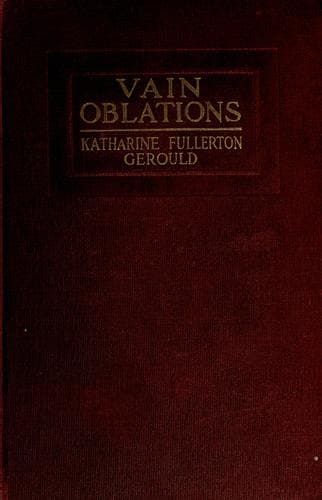
American fiction -- 20th century; Short stories, American
VAIN OBLATIONS
VAIN OBLATIONS
BY
KATHARINE FULLERTON GEROULD
NEW YORK
CHARLES SCRIBNER’S SONS
1914
_Copyright, 1914, by Charles Scribner’s Sons_
_Published March, 1914_
TO
J. M. F. AND B. M. F.
CONTENTS
PAGE
_Vain Oblations_ 1
_The Mango-Seed_ 43
_The Wine of Violence_ 83
_On the Staircase_ 127
_The Tortoise_ 177
_The Divided Kingdom_ 233
_The Case of Paramore_ 273
VAIN OBLATIONS
As I was with Saxe during the four most desperate weeks of his life, I
think I may say that I knew him better than any one else. Those were
also the four most articulate weeks, for they were a period of terrible
inaction, spent on the decks of ocean steamships. Saxe was not much
given to talking, but there was nothing else to do. No book that has
ever been written could have held his attention for two minutes. I was
with him, for that matter, off and on, until the end. What I have to
tell I got partly from my own observation, partly from a good little
woman at the Mission, partly from Saxe’s letters, largely from his own
lips, and partly from natives. But if I recorded it as it came,
unassimilated, unchronologized--one fact often limping into camp six
months after its own result--the story would be as unintelligible as the
_quipus_ of the Incas. It has taken me three years of steady staring to
see the thing whole. I know more about it now--including Saxe--than
Saxe ever knew. In point of fact, one of the most significant pieces of
evidence did not come in until after his death. (I wish it clearly
understood, by the way, that Saxe did not commit suicide.) But, more
than that, I have been thinking for three years about Mary Bradford. I
could tell you as much about what she suffered--the subtlety and the
brutality of her ordeal--as if she were one of my own heroines. God
forbid that I should ever think of Mary Bradford as “material”: that I
should analyze her, or dramatize her, or look at her with the artist’s
squint. If I tell her story, it is because I think it right that we
should know what things can be. For the most part, we keep to our own
continents: the cruel nations are the insensitive nations, and the
squeamish races are kind. But Mary Bradford was the finest flower of New
England; ten home-keeping generations only lay between her and the Quest
of 1620.
Public-domain text, read in full here on John Shaqi.
Reviews
Reviews
No reviews yet
Be the first to share your thoughts on this work.
Join the Discussion
Join the discussion
Sign in to leave a comment or review.
Sign InorCreate an account