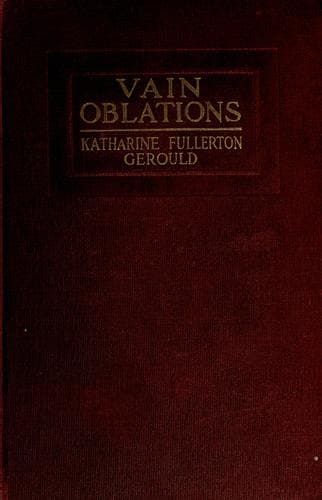
American fiction -- 20th century; Short stories, American
It is chronic hyperæsthesia simply to _be_ New English; and the
pure-bred New Englander had best stick to the euphemisms, the
approximations, the reticences, of his own extraordinary villages. But
Mary Bradford encountered all the physical realities of life in their
crudest form, alone, in the obscene heart of Africa, with black faces
thrust always between her and the sky. Some cynic may put in his
belittling word to the effect that the New Englander has always counted
physical suffering less than spiritual discomfort. The mental torture
was not lacking in Mary Bradford’s case. For over a year, the temptation
to suicide must have been like a terrible thirst, death--any
death--luring her like a rippling spring. I told Saxe one night in
mid-Atlantic, to comfort him, that she would of course have killed
herself if she saw no chance of escape.
Saxe laughed dryly. “That’s the most damnable thing about it,” he said.
“Mary would think it mortal sin to kill herself. She would stick on as
long as God chose to keep the breath in her body.”
“Sin?” I queried rather stupidly.
“Yes, sin,” he answered. “You don’t know anything about it: you were
brought up in Europe.”
“But Saxe,” I cried, “rather than--” I did not finish.
“You don’t know anything about New England,” he said. “Damn your books!
Missionaries face everything, and there’s more than one kind of
martyrdom. I hope she’s dead. I rather think she is.”
His voice was uneven, but with a meaningless unevenness like a boy’s
that is changing. There was no emotion in it. A week more of monotonous
ploughing of the waves would just have broken him, I think; but he
pulled himself together when he touched the soil of Africa. Something in
him went out to meet the curse that hung low over the land in the tropic
afternoon; and encountering the Antagonist, his eyes grew sane again.
But with sanity came the reticence of battle. All that I know of Saxe’s
and Mary Bradford’s early lives, I learned in those four weeks. I have
made out some things about her, since then, that probably Saxe never
knew. As I said, I have been thinking about Mary Bradford for three
years, and it is no secret that to contemplate is, in the end, to know.
The stigmata received by certain saints are, I take it, irrefutable
proof of this. I do not pretend to carry upon me Mary Bradford’s wounds;
I do not even canonize her in my heart. But I seriously believe that she
had, on the whole, the most bitter single experience ever undergone by
woman; and much of the extraordinary horror of the adventure came from
the very exquisiteness of the victim. I have often wondered if the Greek
and Italian literatures that she knew so well offered her any mitigating
memory of a woman more luckless than she. Except Jocasta, I positively
cannot think of one; and Jocasta never lived. All of us have dreams of a
market where we could sell our old lamps for new. How must not Mary
Bradford have longed to change her humanities against mere foothold on
Public-domain text, read in full here on John Shaqi.
Reviews
Reviews
No reviews yet
Be the first to share your thoughts on this work.
Join the Discussion
Join the discussion
Sign in to leave a comment or review.
Sign InorCreate an account