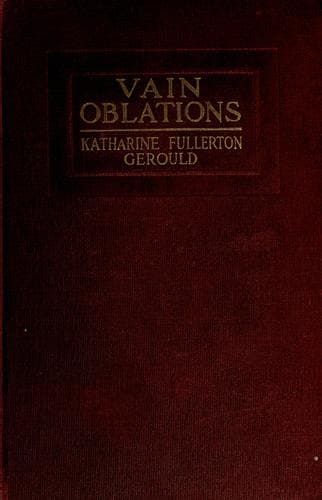
American fiction -- 20th century; Short stories, American
She went on then. Apparently his ironic question had smitten the rock,
for the fluent tale gushed forth, watering all the arid past. But to
Peter it was as if a man blinded and drenched with spray should try to
drink of it. The first sentences came too quickly. In all his two and
twenty years they found no context. He had still to learn the way of
them. He supposed it was because he was finding out at last what it was
to have a real mother.
“It wasn’t always Tahiti,” he heard her saying after a little. “We’ve
tried everything south of the equator, I’ve sometimes thought.
Valparaiso, for a long time. Perhaps you knew? Spencer Martin----”
“Never even told me when you changed your continent.” He was blandly
bitter. Somehow it did hurt, as she went on.
“The climate,” Mrs. Wayne murmured again. And then she named other
stages of their progress--all places, Peter reflected, that were in the
geographies and in Kipling, and nowhere else. It made his parents sound
like vagabonds of fiction. Her trailing narrative did not add to their
reality. The details she mentioned were wildly exotic, and those she
took for granted he could not supply. Her careful English was
interlarded with strange scraps of Spanish and native names for things
which left the objects, for him, unrecognizable. He made nothing out of
it except that it wasn’t what he should call a life at all. He didn’t
even see whether it was whim or necessity that controlled them. As soon
as anything in her story became coherent or comprehensible, she doubled
on her tracks. At first he threw in occasional questions, but the
answers didn’t explain; and soon he stopped asking them. A foreignness
like that left his very curiosities unphraseable. He came to the point
where he didn’t even know what it was that he wanted to know. There was,
to be sure, the irregularly recurrent stress on the hope of health, an
obsession, apparently, under which they had faintly struggled and madly
rambled; but it didn’t make much more sense than what he had learned in
childhood about Ponce de Leon. You might as well ask a firefly to show
you your way. Clearly, she hadn’t the gift of biography. He sat very
still and intent, trying to make a pattern out of it; but she merely
succeeded in dazing him. Then suddenly, when he was most bewildered, it
came to an end, ran out in a mere confession of failure.
“And nowhere, at any time, has the miracle happened. He has never been
well enough to come back. We have always had to stay away.”
“It must have been a strange life,” Peter mused.
“Strange? It may be. Strange for him, no doubt: so fitted for
civilization--for your world.”
“You speak as if it weren’t yours.”
“Oh, mine,” she said simply; “_he_ was mine. I don’t ask for more
civilization than that--than my husband.”
Public-domain text, read in full here on John Shaqi.
Reviews
Reviews
No reviews yet
Be the first to share your thoughts on this work.
Join the Discussion
Join the discussion
Sign in to leave a comment or review.
Sign InorCreate an account