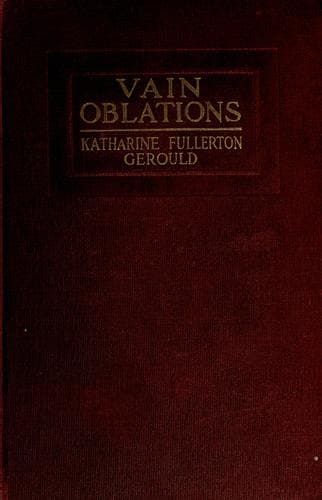
American fiction -- 20th century; Short stories, American
My first feeling, I remember, was one of impotent anger--the child’s
raving at the rain--that I must spend the night in that house. It was
preposterous that life should ask it of me. Talk of white nights! What,
pray, would be the color of mine? Then I, in my turn, “pulled myself
together.” I went back to the newspapers and examined them all. The
little file was arranged in chronological order and was coextensive with
the Upcher case, from arrest to announcement of the execution. The _Orb_
might have been a little fuller, but not much. The West had not been
fickle to Filippo.
I sat staring at the neatly folded papers for a time. They seemed to me
monstrous, not fit to touch, as if they were by no means innocent of
Filippo Upcher’s fate. By a trick of nerves and weak lamplight, there
seemed to be nothing else in the room. I was alone in the world with
them. How long I sat there, fixing them with eyes that must have shown
clear loathing, I have never known. There are moments like that, which
contrive cunningly to exist outside of Time and Space, of which you
remember only the quality. But I know that when I heard steps in the
corridor, I was sure for an instant that it was Filippo Upcher
returning. I was too overwrought to reflect that, whatever the perils of
Rachel Upcher’s house might be, the intrusion of the dead Filippo was
not one of them: that he would profit resolutely by the last league of
those fortunate distances--if so it chanced, by the immunity of very
Hell. It could not be Filippo’s hand that knocked so nervously on the
door. Nor was it. I opened to Rachel Upcher. The first glance at her
face, her eyes, her aimless, feverish, clutching hands, showed that the
spell had at last been broken. She had taken off her black dress and was
wrapped in loose, floating, waving pink. Have you ever imagined the
Erinyes in pink? No other conceivable vision suggests the figure that
stood before me. I remember wondering foolishly and irrelevantly why, if
she could look like that, she had not done Ibsen better. But she brought
me back to fact as she beckoned me out of the room.
“I am sorry--very sorry--but--I was busy with your sister when you came
in, and they have given you the wrong room. I will send some one to move
your things--I will show you your room. Please come--I am sorry.”
I cannot describe her voice. The words came out with difficult,
unnatural haste, like blood from a wound. Between them she clutched at
this or that shred of lace. But I could deal better even with frenzy
than with the mask that earlier I had so little contrived to disturb. I
felt relieved, disburdened. And Filippo was safe--safe. I was free to
deal as I would.
I stepped back into the room. The pile of papers no longer controlled my
nerves. After all, they had been but the distant reek of the monster. I
went over and lifted them, then faced her.
“Is this what you mean by the wrong room?”
Public-domain text, read in full here on John Shaqi.
Reviews
Reviews
No reviews yet
Be the first to share your thoughts on this work.
Join the Discussion
Join the discussion
Sign in to leave a comment or review.
Sign InorCreate an account