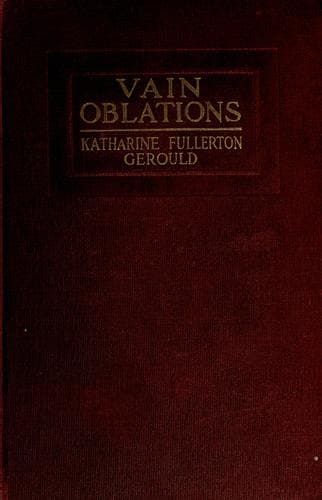
American fiction -- 20th century; Short stories, American
Mrs. Upcher kept her promise. She pulled herself together and came to
dinner, in a high black dress without so much as a white ruche to
relieve it. The manager of the ranch, a young Englishman named Floyd,
dined with us. He was handsome in a bloodshot way, and a detrimental, if
ever there has been one. In love with Mrs. Upcher he looked to be; that,
too, in the same bloodshot way. But she clearly had him in perfect
order. The mask, I suppose, had worked. Letitia did her social best, but
her informing talk failed to produce any pleasant effect. It was too
neat and flat. Floyd watched Mrs. Upcher, and she watched the opposite
wall. I did my best to watch no one. We were rather like a fortuitous
group at a provincial _table d’hôte_: dissatisfied with conditions and
determined not to make acquaintance. We were all thankful, I should
think, when the meal was over. Mrs. Upcher made no attempt to amuse us
or make us comfortable. The young manager left for his own quarters
immediately after dinner, and Letitia soon went to her room. I lingered
for a moment, out of decency, thinking Rachel Upcher might want to speak
to me, to ask me something, to cry out to me, to clutch me for some
desperate end. She sat absolutely silent for five minutes; and, seeing
that the spell, whatever it was, was not yet broken, I left her.
I did not go to bed at once. How should I have done that? I was still
listening for that scream, that pistol-shot. Nothing came. I remember
that, after an hour, I found it all receding from me--the Upchers’
crossed emotions and perverted fates. It was like stepping out of a
miasmic mist. Filippo Upcher was dead; and on the other side of the
grave there had been no such encounter for him as I had imagined. And I
had positively seen a demoniac Rachel Upcher waiting for him on that
pale verge! I searched the room for books. There was some Ibsen, which
at that moment I did not want. I rejected, one after one, nearly all the
volumes that the shelves held. It was a stupid collection. I had about
made up my mind to the “Idylls of the King” (they were different enough,
in all conscience, from the Upcher case) when I saw a pile of magazines
on a table in a distant corner. “Something sentimental,” I proposed to
myself, as I went over to ravage them. Underneath the magazines--a
scattered lot, for the most part, of _London Graphics_ and _English
Illustrateds_--I found a serried pack of newspapers: San Francisco and
Denver sheets, running a few months back. I had never seen a Denver
newspaper, and I picked one up to read the editorials, out of a
desultory curiosity rare with me. On the first page, black head-lines
took a familiar contour. I had stumbled on the charwoman’s evidence
against Filippo Upcher. _Rien que ça!_
Public-domain text, read in full here on John Shaqi.
Reviews
Reviews
No reviews yet
Be the first to share your thoughts on this work.
Join the Discussion
Join the discussion
Sign in to leave a comment or review.
Sign InorCreate an account