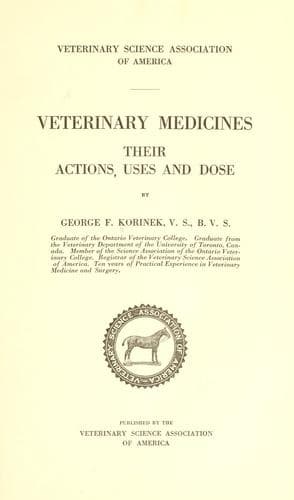
Veterinary Medicines, Their Actions, Uses and Dose — John Shaqi
Veterinary Medicines, Their Actions, Uses and DoseKorinek, George Franklyn
Science
Veterinary Medicines, Their Actions, Uses and Dose
Korinek, George Franklyn
Veterinary drugs
TONIC.--A medicine promoting nutrition and giving strength to the body,
as arsenic, cod liver oil, etc.
TOPIC or TOPICAL.--A substance or agent for external use, applied
locally, as a liniment.
TOXIC.--A condition produced by a poison, as a result of an over-dose of
medicine or the absorption of bacterial products.
TRICOPHYED.--A medicine promoting the growth of hair, as pilocarpine,
cantharides, capsicum, etc.
UTERINE.--A medicine acting upon the uterus, as ergot.
VEHICLE.--A medicine or agent used as a medium or base for the
administration of medicines, as syrups, oils, water, etc.
VERMICIDE.--A medicine which destroys parasitic worms, as turpentine,
iron sulphate, tobacco, creosote, etc.
VERMIFUGE.--A medicine which expels parasitic worms, as arecoline,
aloes, etc.
VESICANT.--A medicine which forms pustules containing white serum, as
cantharides.
VIRUS.--A poison of an infectious disease, especially one found in the
system of an animal suffering from an infectious disease, as hog
cholera, cowpox or rabies virus, etc.
VULNERARY.--Any medicine or compound used in the treatment of wounds, as
ointments, liniments, etc.
ADMINISTRATION OF MEDICINES
The following methods of administering medicines in order of their
rapidity of absorption, beginning with the method by which absorption is
most rapid, and following with those by which absorption is less rapid
and finally least rapid: 1. Intravenous, by injection into veins. 2. By
inhalation (volatile drugs). 3. Subcutaneous, by injection into
subcutaneous tissue. 4. Intratracheal, by injection into the trachea (or
wind pipe). 5. Oral, by the mouth. 6. Rectal, by the rectum. 7.
Inunction, by the skin. 8. Intramammary injections.
WHEN MEDICINES SHOULD BE ADMINISTERED
The curative effects of medicines may be restrained, changed in form or
prevented by untimely administration.
Medicines intended to act on the mucous membrane of the stomach should
only be given when that organ is empty. If distant parts are to be
affected in the most prompt and efficient manner and the medicine is
free from distinct irritating qualities, it should be taken on an empty
stomach; as when digestion is going on, the contents of the stomach are
acid in reaction and if alkalies are given combinations take place and
salts are formed. If alkalies are given before digestion begins,
diffusion of the acid-forming constituents of the blood takes place, and
in this way the acidity of the gastric juice is promoted; likewise acids
given before meals increase the diffusion of the alkaline constituents
of the blood.
METHODS OF ADMINISTERING MEDICINES
Drenching, bit, balling gun, capsule gun, bottle, dose syringe and
hypodermic syringe.
Anaesthetics administered in feed bags or proper inhaler.
TABLES USED IN PRESCRIPTION WRITING
APOTHECARIES OR TROY WEIGHT.
Public-domain text, read in full here on John Shaqi.
Reviews
Reviews
No reviews yet
Be the first to share your thoughts on this work.
Join the Discussion
Join the discussion
Sign in to leave a comment or review.
Sign InorCreate an account