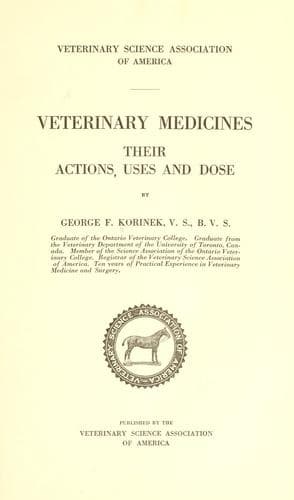
Veterinary Medicines, Their Actions, Uses and Dose — John Shaqi
Veterinary Medicines, Their Actions, Uses and DoseKorinek, George Franklyn
Science
Veterinary Medicines, Their Actions, Uses and Dose
Korinek, George Franklyn
Veterinary drugs
USES.--Boric acid is indicated for all purposes for which an antiseptic
is used; it is used in diarrhoea in foals, calves and dogs, combined
with other drugs; it has a slightly astringent action of itself; it is
excreted in the urine, consequently would exert its influence on the
bladder in cystitis, cystic catarrh; 1 part in 800 prevents the
development of anthrax-bacilli; useful in skin diseases, also used in
keratitis and catarrhal and purulent conjunctivitis, six to ten grains
to the ounce, with atropine or cocaine when very painful. Useful in
distemper of dogs where the bowels are affected, as an antiseptic.
Boric acid is preferred to carbolic acid as an antiseptic for dogs. On
account of the paralyzing effect of carbolic acid on the nerves, it
hinders the healing of wounds to a certain extent, while the boracic
acid does not.
Boric acid may be applied pure to wounds and sores or mixed with other
suitable drugs as a dusting powder. Equal parts of boric acid and zinc
oxide make a cheap and effective healing powder; to an itching wound the
addition of an equal quantity of acetanilide increases its value. A
saturated solution (four per cent) is useful as a vaginal and uterine
douche and to flush the bladder in cystitis.
ACIDUM CARBOLICUM CRUDUM--CRUDE CARBOLIC ACID
DERIVATION.--A liquid consisting of several different constituents of
coal tar, particularly creosol and phenol, obtained by fractional
distillation.
PROPERTIES.--A nearly colorless, or reddish-brown liquid of a strong
disagreeable and creosote-like odor, and gradually turning darker on
exposure to the air and light. Soluble in fifteen parts of water.
PHENOL--ACIDUM CARBOLICUM--CARBOLIC ACID
DERIVATION.--Obtained from crude carbolic acid by agitation with caustic
soda, heating to 338° F., and adding hydrochloric acid. Then by
agitation with sodium chloride, digestion with calcium chloride, and
distillation at a temperature between 336° F. and 374° F. and finally by
crystallization.
PROPERTIES.--Phenol in its pure state is a solid at ordinary
temperatures, crystallizing in minute plates or long rhomboidal needles,
white or colorless, of a peculiar odor recalling that of creosote, and
an acrid burning taste. It is likely to be colored pinkish or brown
under the influence of light and air. Soluble in about 19.6 parts of
water, and very soluble in alcohol, ether, chloroform, glycerin, fixed
and volatile oils.
ACTIONS.--Phenol in large and undiluted doses is an irritant and
narcotic poison; it is used as an antiseptic, parasiticide, antiferment
and sometimes used as a local anaesthetic or anodyne in a 2 to 5 per
cent solution; also as a caustic, but should not be used as a caustic as
a burn from it heals very slowly.
Public-domain text, read in full here on John Shaqi.
Reviews
Reviews
No reviews yet
Be the first to share your thoughts on this work.
Join the Discussion
Join the discussion
Sign in to leave a comment or review.
Sign InorCreate an account