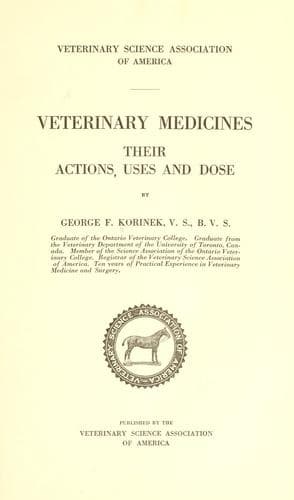
Veterinary Medicines, Their Actions, Uses and DoseKorinek, George Franklyn
Science
Veterinary Medicines, Their Actions, Uses and Dose
Korinek, George Franklyn
Veterinary drugs
PROPERTIES.--The fresh leaves have a faint narcotic odor, most sensible
when they are rubbed. Their taste is at first bitterish and herbaceous,
afterwards burning and acrid, with a feeling of numbness and tingling on
the inside of the lips, tongue and fauces, which is very durable,
lasting sometimes many hours. When long chewed they inflame the tongue.
The dried leaves have a similar taste, but the acrid impression
commences later. Their sensible properties and medical activity are
impaired by long keeping. They should be of a green color, and free from
mustiness. The root has a feeble earthy odor. Though sweetish at first,
it has afterwards the same effect as the leaves upon the mouth and
fauces. It shrinks much in drying and becomes darker, but does not lose
its acrimony. Those parcels, whether of leaves or roots, should always
be rejected which are destitute of this property. Aconite root is
officially described as being “slenderly conical, 4 to 10 cm. long, 10
to 20 mm. thick at the crown; occasionally split; longitudinally
wrinkled; dark brown and marked with coarse whitish root-scars; fracture
short, horny or mealy; internally whitish or light brown; the cambium
zone irregular and 5 to 7-angled; odor very slight; taste sweetish, soon
becoming acrid and developing a tingling sensation, followed by
numbness.”
Preparations of the leaves are not official in the U. S. P. The root is
five times stronger than the leaves.
CONSTITUENTS.--The alkaloid representing the action of the drug is
aconitine, which is precipitated by ammonia from an aqueous solution of
an alcoholic extract of the root of various species. It is a colorless,
crystalline or amorphous, gray powder, almost insoluble in water, and
soluble in 22 parts of alcohol, in 44 parts of ether and 1 part of
chloroform. Its salts are soluble in water. Aconitine or its solutions,
unless very dilute, are too poisonous to be tasted.
Commercial preparations vary in purity and strength, and since it is
extremely poisonous its internal administration is undesirable.
Pseudo-aconitine, aconitine and other alkaloids in combination with
aconitic acid have been obtained from aconite, but their identity and
chemistry are uncertain.
DOSE.--Horses and cattle, 3 to 20 grs.; sheep and pigs, 1 to 3 grs.;
dogs, ¹⁄₁₀ to ¹⁄₁₁ gr.
PREPARATIONS
FLUIDEXTRACTUM ACONITI--FLUIDEXTRACT OF ACONITE
Made by maceration and percolation with alcohol and water and
evaporation. Assayed so that each 100 c. c. contains 0.4 gm. aconitine.
DOSE.--Horses and cattle, 5 to 20 m.; sheep and pigs. 2 to 5 m.; dogs,
¹⁄₁₀ to 1 m.
TINCTURA ACONITI--TINCTURE ACONITE
Made by maceration and percolation of aconite, 100; with alcohol and
water to make 1000.
DOSE.--Horses and cattle, 20 m. to 1 dr.; sheep and pigs, 10 to 20 m.;
dogs, 2 to 10 m.
Fleming’s Tincture (non-official) (79 per cent).
DOSE.--Horses and cattle, 8 to 20 m.; dogs, ¹⁄₂ to 2 m.
ACONITINA--ACONITINE
Public-domain text, read in full here on John Shaqi.
Reviews
Reviews
No reviews yet
Be the first to share your thoughts on this work.
Join the Discussion
Join the discussion
Sign in to leave a comment or review.
Sign InorCreate an account