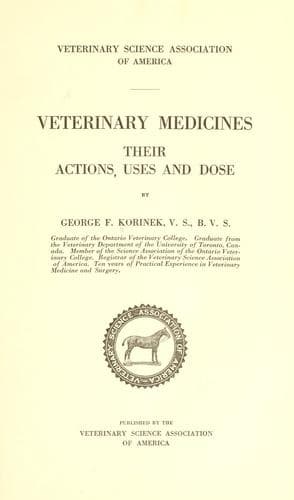
Veterinary Medicines, Their Actions, Uses and DoseKorinek, George Franklyn
Science
Veterinary Medicines, Their Actions, Uses and Dose
Korinek, George Franklyn
Veterinary drugs
Not used to any extent in veterinary practice; is very unreliable and
varying in strength. Aconitine often contains a considerable proportion
of aconite and benzaconine, and so varies in activity, which is a great
objection to the use of one of the most powerful drugs known.
DOSE.--Horses and cattle, ¹⁄₃₀ to ¹⁄₅ gr.; dogs, ¹⁄₂₀₀ to ¹⁄₁₀₀ gr.
subcutaneously.
Actions of aconite, its preparations and derivative are anodynes and
sedatives, acting specially on the peripheral endings of the sensory
nerves, on the heart and on respiration. Aconite kills by respiratory
arrest.
Its physiological actions as a cardiac and respiratory sedative renders
it a febrifuge; it is also diaphoretic and diuretic. It is prescribed in
acute febrile conditions, and in the earlier stages of acute local
inflammation. It is used topically to relieve pain.
GENERAL ACTIONS.--Locally applied, in virtue of its action on sensory
nerves, aconite produces first irritation, tingling and twitching and
subsequently numbness and anesthesia. The tincture of aconite is
rapidly absorbed and quickly passed into the tissues, as is shown by
the blood of a poisoned dog five minutes after the drug has been
administered, being transferred into the veins of another dog without
producing the physiological action of the poison.
TOXIC EFFECTS.--One and one-half drachm of the tincture (equal to about
one drachm of aconite root) is given as the minimum fatal dose for the
horse, one-half drachm will occasionally cause very serious symptoms and
where an idiosyncrasy exists as little as fifteen minims will cause
toxic symptoms.
It causes great muscular weakness, dimness of sight; pupil at first may
be dilated or contracted, but as the end approaches remains dilated;
shallow irregular and labored respiration, a slow and small pulse,
becoming rapid and imperceptible near the end. Gulping, frothy saliva,
flatulence, belching, retching, nausea, etc. There is often a peculiar
clicking sound made from the constant attempts at swallowing.
Coldness of surface, clammy sweat, anxious countenance, extreme weakness
of the extremities, lowering of temperature 2 to 3 degrees, abolishment
of sensation, reflexes and motility and finally death from paralysis of
the heart and respiration, with or without convulsions, consciousness
being preserved until near the end, when carbon dioxide narcosis sets
in.
Public-domain text, read in full here on John Shaqi.
Reviews
Reviews
No reviews yet
Be the first to share your thoughts on this work.
Join the Discussion
Join the discussion
Sign in to leave a comment or review.
Sign InorCreate an account