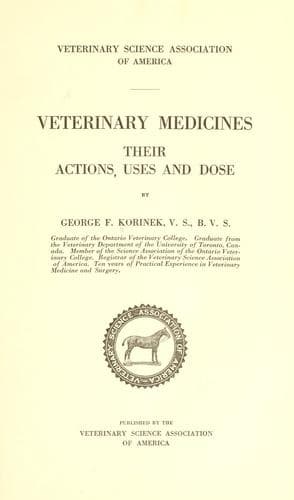
Veterinary Medicines, Their Actions, Uses and Dose — John Shaqi
Veterinary Medicines, Their Actions, Uses and DoseKorinek, George Franklyn
Science
Veterinary Medicines, Their Actions, Uses and Dose
Korinek, George Franklyn
Veterinary drugs
ORIGIN.--The anise plant is a native of Egypt and the Levant, but has
been introduced in various parts of that continent. It is also
cultivated occasionally in the gardens of this country. The fruit is
abundantly produced in Malta and Spain; in Romagna, in Italy, whence it
is largely exported through Leghorn, and in Central and Southern Russia.
DESCRIPTION.--Ovoid, laterally compressed, 4 to 5 m. m. long; carpels
usually cohering and attached to a slender pedicel; grayish or
greenish-gray to grayish brown; each with a flat face and five light
brown filiform ridges and about 16 oil-tubes; odor and taste agreeable
and aromatic. The anise berries are dried and ground, this being the
form in which it is usually used.
DOSE.--Horses and cattle, 1 to 2 oz.; sheep and pigs, 2 to 3 dr.; dogs,
10 to 30 gr.
OLEUM ANISI--OIL OF ANISE
A volatile oil distilled from the fruit of star anise.
PROPERTIES.--A colorless or pale yellow, thin and strongly refractive
liquid, having the characteristic odor of anise, and a sweetish, mildly
aromatic taste. Specific gravity about 0.975 to 0.985. Soluble in an
equal volume of alcohol.
DOSE.--Horses and cattle, 20 to 30 m.; sheep and pigs, 5 to 10 m.; dogs
and cats, 1 to 5 m.
ACTIONS.--Anise is an aromatic stimulant, stomachic and carminative. It
is used to relieve indigestion and flatulence, to communicate an
agreeable flavor to many medicines, and to diminish the griping of
purgatives. Oil of anise resembles in action other volatile oils.
USES.--The oil of anise is employed with olive oil or alcohol to kill
fleas or lice on dogs, rubbed over the skin; and one drop of the pure
oil may be placed on the feathers of fowl to cause destruction of lice.
The oil of anise is sometimes prescribed to disguise the odor of drugs,
and is ordered in cough mixtures for its expectorant properties.
The fruit is given all animals (generally powdered) on their
food--frequently with sodium bicarbonate and ginger--to relieve mild
forms of indigestion and flatulence through its stomachic and
carminative effects.
ANTIMONII ET POTASSII TARTARS--ANTIMONY AND POTASSIUM TARTRATE--TARTAR
EMETIC
DERIVATION.--Make a white paste with cream of tartar, antimony trioxide
and water. Set aside 24 hours, boil in water 15 minutes and crystallize.
PROPERTIES.--Colorless, transparent crystals of the rhombic system,
becoming opaque and white on exposure to the air, or a white granular
powder without odor and having a sweet, afterwards disagreeable,
metallic taste. Soluble in water, insoluble in alcohol.
DOSE.--Horses and cattle, 2 to 4 dr.; sheep, 2 to 5 gr.; pigs, ¹⁄₂ to 1
gr.; dogs, ¹⁄₁₀ to ¹⁄₂ gr. As an emetic for pigs, 4 to 10 gr.; dogs, 1
to 2 gr.
Public-domain text, read in full here on John Shaqi.
Reviews
Reviews
No reviews yet
Be the first to share your thoughts on this work.
Join the Discussion
Join the discussion
Sign in to leave a comment or review.
Sign InorCreate an account