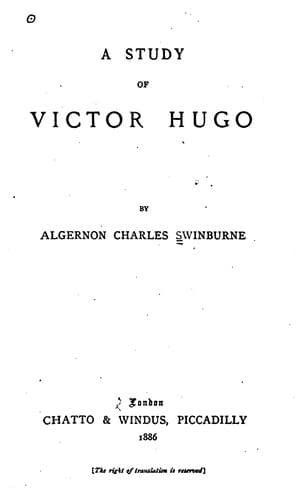
Hugo, Victor, 1802-1885 -- Criticism and interpretation
Gardez-la.--Seulement je me suis mis en tête
De venir vous troubler ainsi dans chaque fête,
Et jusqu'à ce qu'un père, un frère, ou quelque époux,
--La chose arrivera,--nous ait vengés de vous,
Pâle, à tous vos banquets, je reviendrai vous dire:
--Vous avez mal agi, vous avez mal fait, sire!--
Et vous m'écouterez, et votre front terni
Ne se relèvera que quand j'aurai fini.
Vous voudrez, pour forcer ma vengeance à se taire,
Me rendre au bourreau. Non. Vous ne l'oserez faire,
De peur que ce ne soit mon spectre qui demain
(_Montrant sa tête_)
Revienne vous parler,--cette tête à la main!
_Marion de Lorme_ had been prohibited by Charles the Tenth for an
imaginary reflection on Charles the Tenth; _Le Roi s'amuse_ was
prohibited by Louis-Philippe the First--and Last--for an imaginary
reflection on Citizen Philippe Egalité. Victor Hugo vindicated his
meaning and reclaimed his rights in a most eloquent, most manly, and
most unanswerable speech before a tribunal which durst not and could not
but refuse him justice. Early in the following year he brought out the
first of his three tragedies in prose--in a prose which even the most
loyal lovers of poetry, Théophile Gautier at their head, acknowledged
on trial to be as good as verse. And assuredly it would be, if any prose
ever could: which yet I must confess that I for one can never really
feel to be possible. _Lucrèce Borgia_, the first-born of these three,
is also the most perfect in structure as well as the most sublime in
subject. The plots of all three are equally pure inventions of tragic
fancy: Gennaro and Fabiano, the heroic son of the Borgia and the caitiff
lover of the Tudor, are of course as utterly unknown to history as is
the self-devotion of the actress Tisbe. It is more important to remark
and more useful to remember that the master of terror and pity, the
command of all passions and all powers that may subserve the purpose of
tragedy, is equally triumphant and infallible in them all. _Lucrèce
Borgia_ and _Marie Tudor_ appeared respectively in February and in
November of the year 1833; _Angelo_, two years later; and the year after
this the exquisite and melodious libretto of _La Esmeralda_, which
should be carefully and lovingly studied by all who would appreciate the
all but superhuman versatility and dexterity of metrical accomplishment
which would have sufficed to make a lesser poet famous among his peers
forever, but may almost escape notice in the splendor of Victor Hugo's
other and sublimer qualities. In his thirty-seventh year all these
blazed out once more together in the tragedy sometimes apparently rated
as his master-work by judges whose verdict would on any such question be
worthy at least of all considerate respect. No one that I know of has
ever been absurd enough to make identity in tone of thought or feeling,
in quality of spirit or of style, the ground for a comparison of Hugo
with Shakespeare: they are of course as widely different as are their
Public-domain text, read in full here on John Shaqi.
Reviews
Reviews
No reviews yet
Be the first to share your thoughts on this work.
Join the Discussion
Join the discussion
Sign in to leave a comment or review.
Sign InorCreate an account