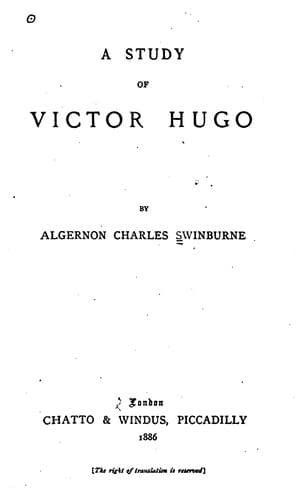
Hugo, Victor, 1802-1885 -- Criticism and interpretation
republics; one, misnamed a commonweal, the rule of the red flag, of
barbarism and blindness, communism and proscription and revenge; the
other a commonwealth indeed, in which all rights should be respected and
no duties evaded or ignored; a government of justice and mercy, of
practicable principles and equitable freedom, of no iniquitous
traditions and no utopian aims. To establish this kind of commonwealth
and prevent the resurrection of the other, Hugo, at the age of
forty-six, professed himself ready to devote his life. The work of
thirty-seven years is now before all men's eyes for proof how well this
promise has been kept. On dangerous questions of perverse or perverted
socialism (June 20, 1848), on the freedom of the press, on the state of
siege, its temporary necessity and its imminent abuse, on the
encouragement of letters and the freedom of the stage, he spoke, in the
course of a few months, with what seems to my poor understanding the
most admirable good sense and temperance, the most perfect moderation
and loyalty. I venture to dwell upon this division of Hugo's life and
labors with as little wish of converting as I could have hope to convert
that large majority whose verdict has established as a law of nature the
fact or the doctrine that "every poet is a fool" when he meddles with
practical politics; but not without a confidence grounded on no
superficial study that the maintainers of this opinion, if they wish to
cite in support of it the evidence supplied by Victor Hugo's political
career, will do well to persevere in the course which I will do them the
justice to admit that--as far as I know--they have always hitherto
adopted; in other words, to assume the universal assent of all persons
worth mentioning to the accuracy of this previous assumption, and
dismiss with a quiet smile or an open sneer the impossible notion that
any one but some single imbecile or eccentric can pretend to take
seriously what seems to them ridiculous, or to think that ridiculous
which to their wiser minds commends itself as serious. This beaten road
of assumption, this well-worn highway of assertion, is a safe as well as
a simple line of travel: and the practical person who keeps to it can
well afford to dispense with argument as palpably superfluous, and with
evidence as obviously impertinent. Should he so far forget that great
principle of precaution as to diverge from it into the modest and simple
course of investigation and comparison of theory with fact and
probability with proof, his task maybe somewhat harder, and its result
somewhat less satisfactory. I would not advise any but an honest and
candid believer in the theory which identifies genius with idiocy--which
at all events would practically define one special form of genius as a
note of general idiocy--to study the speeches (they are nine in number,
including two brief and final replies to the personal attacks of one
Montalembert, whose name used to be rather popular among a certain class
Public-domain text, read in full here on John Shaqi.
Reviews
Reviews
No reviews yet
Be the first to share your thoughts on this work.
Join the Discussion
Join the discussion
Sign in to leave a comment or review.
Sign InorCreate an account