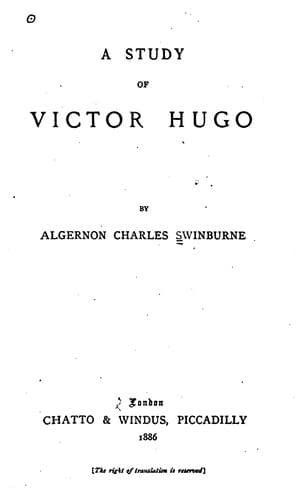
Hugo, Victor, 1802-1885 -- Criticism and interpretation
People," with a threefold cry for burden, calling on the buried Lazarus
to rise again in words that seem to reverberate from stanza to stanza
like peal upon peal of living thunder, prolonged in steadfast cadence
from height to height across the hollows of a range of mountains, is one
of the most wonderful symphonies of tragic and triumphant verse that
ever shook the hearts of its hearers with rapture of rage and pity. The
first and the two last stanzas seem to me absolutely unsurpassed and
unsurpassable for pathetic majesty of music.
Partout pleurs, sanglots, cris funèbres.
Pourquoi dors-tu dans les ténèbres?
Je ne veux pas que tu sois mort.
Pourquoi dors-tu dans les ténèbres?
Ce n'est pas l'instant où l'on dort.
La pâle Liberté gît sanglante à ta porte.
Tu le sais, toi mort, elle est morte.
Voici le chacal sur ton seuil,
Voici les rats et les belettes,
Pourquoi t'es-tu laissé lier de bandelettes?
Ils te mordent dans ton cercueil!
De tous les peuples on prépare
Le convoi...--
Lazare! Lazare! Lazare!
Lève-toi!
* * * * * *
Ils bâtissent des prisons neuves;
Ô dormeur sombre, entends les fleuves
Murmurer, teints de sang vermeil;
Entends pleurer les pauvres veuves,
Ô noir dormeur au dur sommeil!
Martyrs, adieu! le vent souffle, les pontons flottent,
Les mères au front gris sanglotent;
Leurs fils sont en proie aux vainqueurs;
Elles gémissent sur la route;
Les pleurs qui de leurs yeux s'échappent goutte à goutte
Filtrent en haine dans nos cœurs.
Les juifs triomphent, groupe avare
Et sans foi...--
Lazare! Lazare! Lazare!
Lève-toi!
Mais, il semble qu'on se réveille!
Est-ce toi que j'ai dans l'oreille,
Bourdonnement du sombre essaim?
Dans la ruche frémit l'abeille;
J'entends sourdre un vague tocsin.
Les césars, oubliant qu'il est des gémonies,
S'endorment dans les symphonies,
Du lac Baltique au mont Etna;
Les peuples sont dans la nuit noire;
Dormez, rois; le clairon dit aux tyrans: victoire!
Et l'orgue leur chante; hosanna!
Qui répond à cette fanfare?
Le beffroi...--
Lazare! Lazare! Lazare!
Lève-toi!
If ever a more superb structure of lyric verse was devised by the brain
of man, it must have been, I am very certain, in a language utterly
unknown to me. Every line, every pause, every note of it should be
studied and restudied by those who would thoroughly understand the
lyrical capacity of Hugo's at its very highest point of power, in the
fullest sweetness of its strength.
About the next poem--'Souvenir de la nuit du 4'--others may try, if they
please, to write, if they can; I can only confess that I cannot. Nothing
so intolerable in its pathos, I should think, was ever written.
The stately melody of the stanzas in which the exile salutes in a tone
of severe content the sorrows that environ and the comforts that sustain
him, the island of his refuge, the sea-birds and the sea-rocks and the
sea, closes aptly with yet another thought of the mothers weeping for
their children.
Public-domain text, read in full here on John Shaqi.
Reviews
Reviews
No reviews yet
Be the first to share your thoughts on this work.
Join the Discussion
Join the discussion
Sign in to leave a comment or review.
Sign InorCreate an account