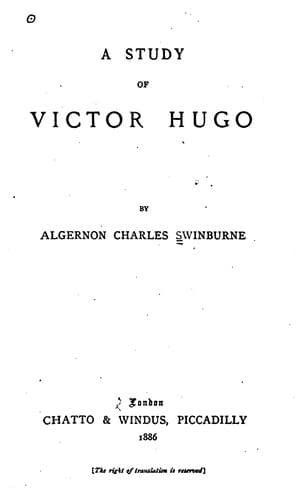
Hugo, Victor, 1802-1885 -- Criticism and interpretation
The next poem is addressed to a disappointed accomplice of the crime
still triumphant and imperial in the eyes of his fellow-scoundrels, who
seems to have shown signs of a desire to break away from them and a
suspicion that even then the ship of empire was beginning to
leak--though in fact it had still seventeen years of more or less
radiant rascality to float through before it foundered in the ineffable
ignominy of Sedan. Full of ringing and stinging eloquence, of keen and
sonorous lines or lashes of accumulating scorn, this poem is especially
noteworthy for its tribute to the murdered republic of Rome. Certain
passages in certain earlier works of Hugo, in _Cromwell_ for instance
and in _Marie Tudor_, had given rise to a natural and indeed inevitable
suspicion of some prejudice or even antipathy on the writer's part which
had not less unavoidably aroused a feeling among Italians that his
disposition or tone of mind was anything but cordial or indeed amicable
towards their country: a suspicion probably heightened, and a feeling
probably sharpened, by his choice of such dramatic subjects from Italian
history or tradition as the domestic eccentricities of the exceptional
family of Borgia, and the inquisitorial misdirection of the degenerate
commonwealth of Venice. To the sense that Hugo was hardly less than an
enemy and that Byron had been something more than a well-wisher to Italy
I have always attributed the unquestionable and otherwise inexplicable
fact that Mazzini should have preferred the pinchbeck and tinsel of
Byron to the gold and ivory of Hugo. But it was impossible that the
master poet of the world should not live to make amends, if indeed
amends were needed, to the country of Mazzini and of Dante.
Public-domain text, read in full here on John Shaqi.
Reviews
Reviews
No reviews yet
Be the first to share your thoughts on this work.
Join the Discussion
Join the discussion
Sign in to leave a comment or review.
Sign InorCreate an account