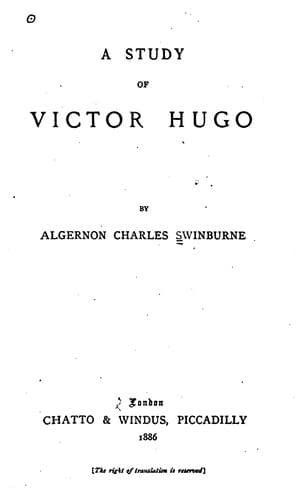
Hugo, Victor, 1802-1885 -- Criticism and interpretation
The sewer of Rome, a final receptacle for dead dogs and rotting Cæsars,
is painted line by line and detail by detail in verse which touches with
almost frightful skill the very limit of the possible or permissible to
poetry in the way of realistic loathsomeness or photographic horror;
relieved here and there by a rare and exquisite image, a fresh breath or
tender touch of loveliness from the open air of the daylight world
above. The song on the two Napoleons is a masterpiece of skilful
simplicity in contrast of tones and colors. But the song which follows,
written to a tune of Beethoven's, has in it something more than the
whole soul of music, the whole passion of self-devoted hope and
self-transfiguring faith; it gives the final word of union between sound
and spirit, the mutual coronation and consummation of them both.
_PATRIA_
La-haut qui sourit?
Est-ce un esprit?
Est-ce une femme?
Quel front sombre et doux!
Peuple, à genoux!
Est-ce notre âme
Qui vient à nous?
Cette figure en deuil
Paraît sur notre seuil,
Et notre antique orgueil
Sort du cercueil.
Ses fiers regards vainqueurs
Réveillent tous les cœurs,
Les nids dans les buissons,
Et les chansons.
C'est l'ange du jour;
L'espoir, l'amour
Du cœur qui pense;
Du monde enchanté
C'est la clarté.
Son nom est France
Ou Vérité.
Bel ange, à ton miroir
Quand s'offre un vil pouvoir,
Tu viens, terrible à voir,
Sous le ciel noir.
Tu dis au monde: Allons!
Formez vos bataillons!
Et le monde ébloui
Te répond: Oui.
C'est l'ange de nuit.
Rois, il vous suit.
Marquant d'avance
Le fatal moment
Au firmament.
Son nom est France
Ou Châtiment.
Ainsi que nous voyons
En mai les alcyons,
Voguez, ô nations,
Dans ses rayons
Son bras aux deux dressé
Ferme le noir passé
Et les portes de fer
Du sombre enfer.
C'est l'ange de Dieu.
Dans le ciel bleu
Son aile immense
Couvre avec fierté
L'humanité.
Son nom est France
Ou Liberté!
The _Caravan_, a magnificent picture, is also a magnificent allegory and
a magnificent hymn. The poem following sums up in twenty-six lines a
whole world of terror and of tempest hurtling and wailing round the
wreck of a boat by night. It is followed by a superb appeal against the
infliction of death on rascals whose reptile blood would dishonor and
defile the scaffold: and this again by an admonition to their chief not
to put his trust in the chance of a high place of infamy among the more
genuinely imperial hellhounds of historic record. The next poem gives us
in perfect and exquisite summary the opinions of a contemporary
conservative on a dangerous anarchist of extravagant opinions and
disreputable character, whom for example's sake it was at length found
necessary to crucify. There is no song more simply and nobly pitiful
than that which tells us in its burden how a man may die for lack of his
native country as naturally and inevitably as for lack of his daily
bread. I cite only the last three stanzas by way of sample.
Public-domain text, read in full here on John Shaqi.
Reviews
Reviews
No reviews yet
Be the first to share your thoughts on this work.
Join the Discussion
Join the discussion
Sign in to leave a comment or review.
Sign InorCreate an account