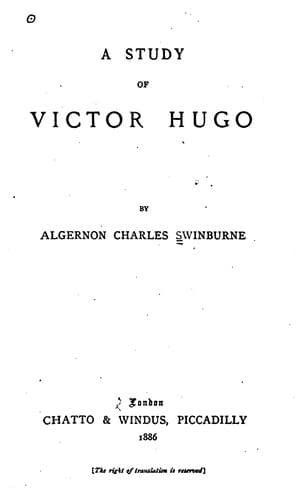
Hugo, Victor, 1802-1885 -- Criticism and interpretation
And then come those majestic "last words" which will ring for ever in
the ears of men till manhood as well as poetry has ceased to have honor
among mankind. And then comes a poem so great that I hardly dare venture
to attempt a word in its praise. We cannot choose but think, as we read
or repeat it, that "such music was never made" since the morning stars
sang together, and all the sons of God shouted for joy. This epilogue of
a book so bitterly and inflexibly tragic begins as with a peal of golden
bells, or an outbreak of all April in one choir of sunbright song;
proceeds in a graver note of deep and trustful exultation and yearning
towards the future; subsides again into something of a more subdued key,
while the poet pleads for his faith in a God of righteousness with the
righteous who are ready to despair; and rises from that tone of
awe-stricken and earnest pleading to such a height and rapture of
inspiration as no Hebrew psalmist or prophet ever soared beyond in his
divinest passion of aspiring trust and worship. It is simply impossible
that a human tongue should utter, a human hand should write, anything of
more supreme and transcendent beauty than the last ten stanzas of the
fourth division of this poem. The passionate and fervent accumulation of
sublimities, of marvelous images and of infinite appeal, leaves the
sense too dazzled, the soul too entranced and exalted, to appreciate at
first or in full the miraculous beauty of the language, the superhuman
sweetness of the song. The reader impervious to such impressions may
rest assured that what he admires in the prophecies or the psalms of
Isaiah or of David is not the inspiration of the text, but the warrant
and sign-manual of the councils and the churches which command him to
admire them on trust.
Ne possède-t-il pas toute la certitude?
Dieu ne remplit-il pas ce monde, notre étude,
Du nadir au zénith?
Notre sagesse auprès de la sienne est démence.
Et n'est-ce pas à lui que la clarté commence,
Et que l'ombre finit?
Ne voit-il pas ramp r les hydres sur leurs ventres?
Ne regarde-t-il pas jusqu'au fond de leurs antres
Atlas et Pélion?
Ne connaît-il pas l'heure où la cigogne émigre?
Sait-il pas ton entrée et ta sortie, ô tigre,
Et ton antre, ô lion?
Hirondelle, réponds, aigle à l'aile sonore,
Parle, avez-vous des nids que l'Eternel ignore?
Ô cerf, quand l'as-tu fui?
Renard, ne vois-tu pas ses yeux dans la broussaille?
Loup, quand tu sens la nuit une herbe qui tressaille,
Ne dis-tu pas: C'est lui!
Puisqu'il sait tout cela, puisqu'il peut toute chose,
Que ses doigts font jaillir les effets de la cause
Comme un noyau d'un fruit,
Puisqu'il peut mettre un ver dans les pommes de l'arbre,
Et faire disperser les colonnes de marbre
Par le vent de la nuit;
Public-domain text, read in full here on John Shaqi.
Reviews
Reviews
No reviews yet
Be the first to share your thoughts on this work.
Join the Discussion
Join the discussion
Sign in to leave a comment or review.
Sign InorCreate an account