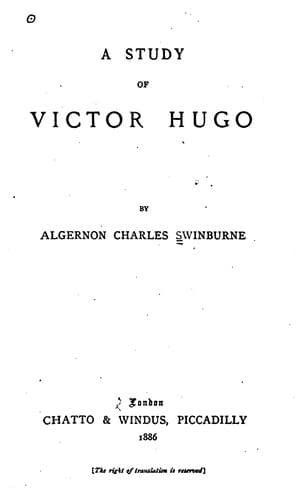
Hugo, Victor, 1802-1885 -- Criticism and interpretation
Je vis un ange blanc qui passait sur ma tête;
Son vol éblouissant apaisait la tempête,
Et faisait taire au loin la mer pleine de bruit.
--Qu'est-ce que tu viens faire, ange, dans cette nuit?
Lui dis-je. Il répondit:--Je viens prendre ton âme.--
Et j'eus peur, car je vis que c'était une femme;
Et je lui dis, tremblant et lui tendant les bras:
--Que me restera-t-il? car tu t'envoleras.--
Il ne répondit pas; le ciel que l'ombre assiège
S'éteignait...--Si tu prends mon âme, m'écriai-je.
Où l'emporteras-tu? montre-moi dans quel lieu.
Il se taisait toujours.--O passant du ciel bleu,
Es-tu la mort? lui dis-je, ou bien es-tu la vie?--
Et la nuit augmentait sur mon âme ravie,
Et l'ange devint noir, et dit:--Je suis l'amour.
Mais son front sombre était plus charmant que le jour,
Et je voyais, dans l'ombre où brillaient ses prunelles,
Les astres à travers les plumes de ses ailes.
If nothing were left of Hugo but the sixth book of the _Contemplations_,
it would yet be indisputable among those who know anything of poetry
that he was among the foremost in the front rank of the greatest poets
of all time. Here, did space allow, it would be necessary for criticism
with any pretense to adequacy to say something of every poem in turn, to
pause for observation of some beauty beyond reach of others at every
successive page. In the first poem a sublime humility finds such
expression as should make manifest to the dullest eye not clouded by
malevolence and insolent conceit that when this greatest of modern poets
asserts in his own person the prerogative and assumes for his own spirit
the high office of humanity, to confront the darkest problem and to
challenge the utmost force of intangible and invisible injustice as of
visible and tangible iniquity, of all imaginable as of all actual evil,
of superhuman indifference as well as of human wrongdoing, it is no
merely personal claim that he puts forward, no vainly egotistic
arrogance that he displays; but the right of a reasonable conscience and
the duty of a righteous faith, common to ail men alike in whom
intelligence of right and wrong, perception of duty or conception of
conscience can be said to exist at all. If there be any truth in the
notion of any difference between evil and good more serious than the
conventional and convenient fabrications of doctrine and assumption,
then assuredly the meanest of his creatures in whom the perception of
this difference was not utterly extinct would have a right to denounce
an omnipotent evil-doer as justly amenable to the sentence inflicted by
the thunders of his own unrighteous judgment. How profound and intense
was the disbelief of Victor Hugo in the rule or in the existence of any
such superhuman malefactor could not be better shown than by the almost
polemical passion of his prophetic testimony to that need for faith in a
central conscience and a central will on which he has insisted again and
again as a crowning and indispensable, requisite for moral and spiritual
Public-domain text, read in full here on John Shaqi.
Reviews
Reviews
No reviews yet
Be the first to share your thoughts on this work.
Join the Discussion
Join the discussion
Sign in to leave a comment or review.
Sign InorCreate an account